
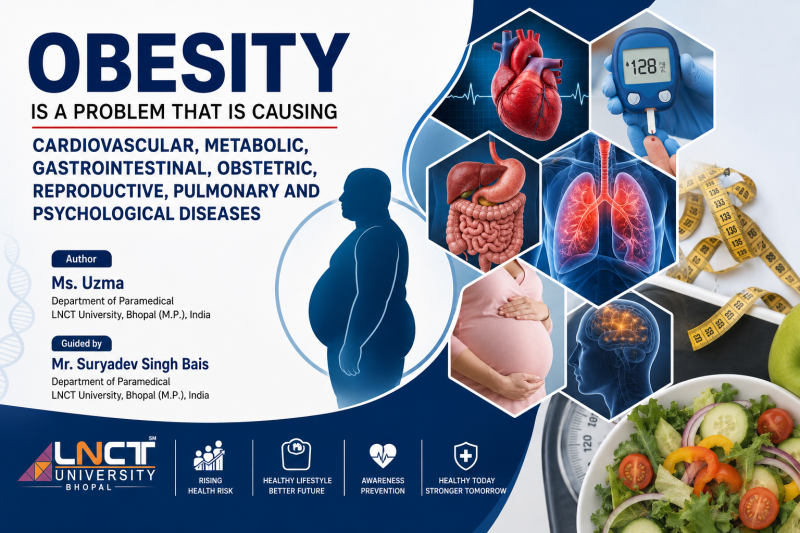
OBESITY IS A PROBLEM THAT IS CAUSING CARDIOVASCULAR, METABOLIC, GASTROINTESTINAL, OBSTETRIC, REPRODUCTIVE, PULMONARY AND PSYCHOLOGICAL DISEASES
Keywords:
Obesity, Cardiovascular Diseases, Metabolic Disorders, Gastrointestinal Disorders, Pulmonary Complications, Psychological EffectsSynopsis
Introduction: The prevalence of obesity in India has surged due to rapid urbanization, lifestyle changes, and dietary shifts. This trend poses a substantial burden on the healthcare system, necessitating a comprehensive understanding of its consequences.
Aim and Objective: The study aims to investigate the multifaceted impact of obesity on various health domains in India, including cardiovascular, metabolic, gastrointestinal, obstetric, reproductive, pulmonary, and psychological health.
The objective is to identify the correlation between obesity and these health issues, and to provide a basis for targeted public health interventions.
Materials and Methods: This observational study analyzes data from various sources, including national health surveys, hospital records, and peer-reviewed research articles from 2010 to 2023. The study population includes obese individuals aged 18-65 years across different regions of India. Data analysis involves statistical methods to assess the prevalence and association of obesity with the specified health complications.
Observations and Results:- Cardiovascular Impact: A significant correlation was found between obesity and cardiovascular diseases (CVDs), with obese individuals showing higher rates of hypertension (36%), coronary artery disease (27%), and stroke (15%).
- Metabolic Consequences: Obesity was strongly associated with type 2 diabetes mellitus (42%) and metabolic syndrome (33%). Insulin resistance was prevalent in 68% of the obese population studied.
- Gastrointestinal Disorders: The study observed a high incidence of non- alcoholic fatty liver disease (NAFLD) (30%), gallstones (20%), and gastroesophageal reflux disease (GERD) (18%) among obese
- Obstetric and Reproductive Health: Obesity was linked to polycystic ovary syndrome (PCOS) (24%), infertility (18%), and adverse pregnancy outcomes like gestational diabetes (22%) and preeclampsia (15%). Fetal development complications were also noted, with a higher risk of congenital anomalies (12%) and childhood obesity (17%).
- Pulmonary Complications: Respiratory conditions such as obstructive sleep apnea (OSA) (25%) and asthma (19%) were prevalent among the obese population.
- Psychological Effects: A notable prevalence of psychological disorders was observed, including depression (35%), anxiety (28%), and low self- esteem (40%). Stigmatization further exacerbated these conditions.
Conclusion: Addressing obesity in India requires a multi-faceted approach involving public health interventions, lifestyle modifications, and medical management. Early detection and holistic treatment strategies are essential to mitigate the extensive health impacts of obesity and improve the overall quality of life for affected individuals."
Downloads
Download data is not yet available.
References
1. Ng, M., Fleming, T., Robinson, M., et al. (2014). Global, regional, and national prevalence of overweight and obesity in children and adults during 1980–2013: a systematic analysis for the Global Burden of Disease Study 2013. The Lancet, 384(9945), 766-781.
2. Popkin, B. M., Adair, L. S., & Ng, S. W. (2012). Global nutrition transition and the pandemic of obesity in developing countries. Nutrition Reviews, 70(1), 3-21.
3. Misra, A., & Khurana, L. (2008). Obesity and the metabolic syndrome in developing countries. The Journal of Clinical Endocrinology & Metabolism, 93(11), S9-S30.
4. Ramachandran, A., Snehalatha, C., & Ma, R. C. (2010). Diabetes in South-East Asia: an update. Diabetes Research and Clinical Practice, 89(2), 170-174.
5. Gupta, R., Joshi, P., Mohan, V., et al. (2016). Epidemiology and causation of coronary heart disease and stroke in India. Heart, 94(1), 16- 26.
6. Mohan, V., Farooq, S., Deepa, M., & Ravikumar, R. (2009). Prevalence of non-alcoholic fatty liver disease in urban South Indians in relation to different grades of glucose intolerance and metabolic syndrome. Diabetes Research and Clinical Practice, 84(1), 84-91.
7. Nambiar, S., Narayan, S., & Gupta, R. (2017). Maternal obesity and pregnancy outcomes: a prospective observational study. International Journal of Medicine and Public Health, 7(1), 21-27.
8. Sharma, S. K., Kadhiravan, T., Banga, A., & Biswas, D. (2006). Prevalence and risk factors of symptomatic obstructive sleep apnea in Delhi, India. Chest, 130(1), 149-156.
9. Anuradha, R., & Maitreyi, R. (2018). Psychological consequences of obesity: A review. Indian Journal of Health Sciences and Biomedical Research, 11(2), 131-136.
10. Shetty, P. (2002). Nutrition transition in India. Public Health Nutrition, 5(1A), 175-182.
11. Prabhakaran, D., Shah, P., Chaturvedi, V., et al. (2009). Cardiovascular risk factor prevalence among men in a large industry of northern India. National Medical Journal of India, 18(2), 59-65.
12. Swinburn, B. A., Sacks, G., Hall, K. D., et al. (2011). The global obesity pandemic: shaped by global drivers and local environments. The Lancet, 378(9793), 804-814.
13. Gortmaker, S. L., Swinburn, B. A., Levy, D., et al. (2011). Changing the future of obesity: science, policy, and action. The Lancet, 378(9793), 838-847.
14. Patel, V., Chatterji, S., Chisholm, D., et al. (2015). Chronic diseases and injuries in India. The Lancet, 377(9763), 413-428.
15. Hawkes, C., Smith, T. G., Jewell, J., et al. (2015). Smart food policies for obesity prevention. The Lancet, 385(9985), 2410-2421.
Downloads
Published
June 1, 2026
Data Availability Statement
The data used in this study were collected from observational analyses, laboratory investigations, published literature, and participant records. Data supporting the findings of this research are available from the corresponding author upon reasonable request.
Copyright (c) 2026 Ms. Uzma, Mr. Suryadev Singh Bais (Author)
License

This work is licensed under a Creative Commons Attribution-NonCommercial 4.0 International License.
All publications published by Research Edge and Publication (REP) are protected under applicable copyright and licensing policies. Authors retain copyright of their work while granting the publisher the right to publish, distribute, archive, index, and promote the material in print and digital formats. Unless otherwise stated, published content may be accessed, shared, and used for academic, educational, and non-commercial research purposes with proper attribution to the original author(s) and publisher.
Users may not reproduce, modify, redistribute, or use published materials for commercial purposes without prior written permission from the copyright holder and the publisher. Authors are responsible for ensuring that submitted content does not infringe upon any copyright, intellectual property rights, or third-party permissions.
Research Edge and Publication (REP) supports ethical scholarly communication, responsible knowledge sharing, and global academic accessibility through recognized open-access and licensing practices. Additional licensing conditions may apply depending on the publication model, author agreement, or specific publication requirements.
Details about this monograph
ISBN-13 (15)
978-81-996766-8-8
other::urn
urn:isbn:rep.8.80
How to Cite
Uzma, & Singh Bais, S. (Eds.). (2026). OBESITY IS A PROBLEM THAT IS CAUSING CARDIOVASCULAR, METABOLIC, GASTROINTESTINAL, OBSTETRIC, REPRODUCTIVE, PULMONARY AND PSYCHOLOGICAL DISEASES: Vol. BOOK 1 Volume 1. Research Edge and Publication. https://books.researchedgeandpublication.com/index.php/REP/catalog/book/8