
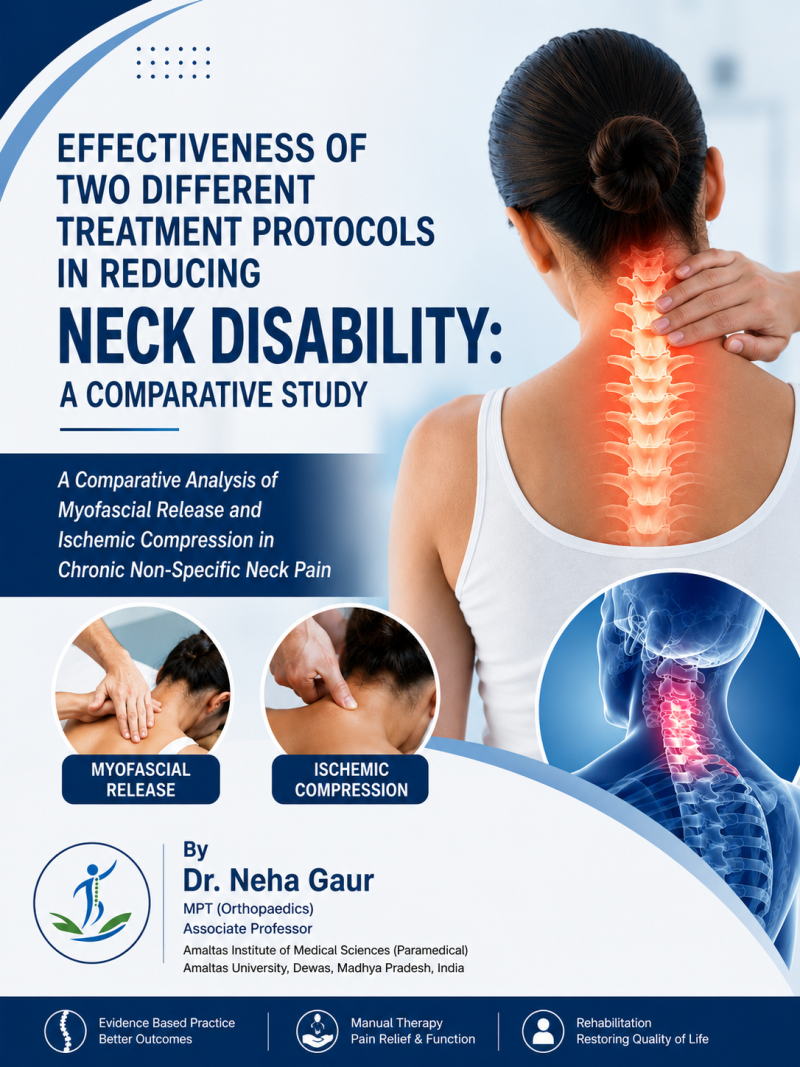
EFFECTIVENESS OF TWO DIFFERENT TREATMENT PROTOCOLS IN REDUCING NECK DISABILITY: A COMPARATIVE STUDY: A Comparative Analysis of Myofascial Release and Ischemic Compression in Chronic Non-Specific Neck Pain
Keywords:
Neck Pain, Non-Specific Neck Pain, Mechanical Neck Pain, Myofascial Trigger Points, Myofascial Pain Syndrome, Myofascial Release Technique, Ischemic Compression, Trigger Point Release, Neck Disability, Cervical Lateral FlexionSynopsis
Neck pain is one of the most common musculoskeletal disorders affecting individuals involved in prolonged sitting, repetitive activities, and poor postural habits. Myofascial trigger points present in cervical muscles are considered a major contributing factor in chronic non-specific neck pain and may lead to pain, reduced cervical mobility, and functional disability. Various manual therapy techniques are used in physiotherapy management for reducing symptoms associated with myofascial trigger points. Among these techniques, Myofascial Release (MFR) and Ischemic Compression (IC) are commonly used interventions.
The present study was conducted to compare the effectiveness of Myofascial Release and Ischemic Compression in reducing pain and neck disability and improving cervical lateral flexion in patients with chronic non-specific neck pain. A comparative study design was used. Fifty subjects aged between 20–60 years who fulfilled the inclusion criteria were selected and randomly divided into two groups of 25 subjects each. Group A received hot fomentation, Myofascial Release technique, and stretching exercises, whereas Group B received hot fomentation, Ischemic Compression technique, and stretching exercises. Treatment was administered once daily for four weeks.
Outcome measures included Visual Analogue Scale (VAS) for pain intensity, Neck Disability Index (NDI) for functional disability, and goniometric measurement of cervical lateral flexion. Assessments were performed before treatment, after two weeks, and after four weeks of intervention.
The results of the study demonstrated improvement in both groups with reduction in pain intensity and neck disability along with increased cervical lateral flexion. However, Group A treated with Myofascial Release showed comparatively greater improvement than Group B treated with Ischemic Compression. Statistical analysis indicated significant changes in VAS, NDI, and cervical lateral flexion values following treatment.
The study concluded that both Myofascial Release and Ischemic Compression are effective in managing chronic non-specific neck pain associated with myofascial trigger points. However, Myofascial Release technique was found to be more effective in reducing pain and disability and improving cervical mobility.
Downloads
Download data is not yet available.
References
1. Ferrari R, Russell AS Regional musculoskeletal conditions: neck pain. Best Pract Res ClinRheumatol 2003:17(1):57–70.
2. Douglass AB, Bope ET. Evaluation and treatment of posterior neck pain in family practice. J Am Board FamPract 2004; 17: S13–22.
3. Bogduk N (1999). The neck. Baillieres ClinRheumatol 13(2):261–285.
4. Haldeman S, Carroll LJ, Cassidy JD, Schubert J, Nygren A (2008). The Bone and Joint Decade 2000–2010 Task Force on Neck Pain and its Associated Disorders: Executive summary. Spine (Phila Pa 1976) 33(Suppl):S5–S7.
5. Aker PD, Gross AR, Golsmith CH, Peloso P. Conservative management of mechanical neck pain: a systematic overview and meta-analysis. BMJ 1996; 313: 1291—6.
6. Dziedzig K, Hill J, Lewis M, Sim J, Daniels J, Hay EM. Effectiveness of manual therapy or pulsed shortwave diathermy in addition to advice and exercise for neck disorders: a pragmatic randomised controlled trail in physical therapy clinics. Arthritis Rheum 2005; 53: 214—22.
7. Saringovallis P, Hollins B. Effectiveness of manual therapy in treatment of nonspecific neck pain: a review. PhysTher Rev 2005; 10: 35—50.
8. Cote P, Cassidy JD, Carroll LJ, Kristman V. The annual incidence and course of neck pain in the general population: a population-based cohort study. Pain 2004; 112: 267–73.
9. Wheeler AH, Goolkasian P, Baird AC, Darden BV (1999) Development of the neck pain and disability scale. Item analysis, face and criterion-related validity. Spine 24(13):1290–1294.
10. Silverman JL, Rodriquez AA, Agre JC. Quantitative cervical flexor strength in healthy subjects and in subjects with mechanical neck pain. Arch Phys Med Rehabil 1992; 72: 679–681.
11. Pietrobon R, Coeytaux RR, Carey TS, Richardson WJ, De Vellis RF (2002) Standard scales for measurement of functional out come for cervical pain or dysfunction: a systematic review. Spine 27(5):515–522
12. Portney LG, Watkins MP (2000) Foundations of Clinical Research, 2nd Ed. Prentice Hall Health., Upper Saddle River, New Jersey
13. Croft P, Lewis M, Papageorgiou A, Thomas E, Jayson M, Macfarlane G et al (2001) Risk factors for neck pain: a longitudinal study in the general population. Pain 93(3):317–325.
14. Binder AI (2007). Cervical spondylosis and neck pain BMJ334 (7592):527–53. 15. Guzman J, Hurwitz EL, Carroll LJ, Haldeman S, Cote P, Carragee EJ et al (2008) A new conceptual model of neck pain. The Bone and Joint Decade 2000 -2010 Task Force on Neck Pain and its Associated Disorders. Spine (Phila Pa 1976) 33(Suppl):S14–S22.
16. Simeon Niel Asher. The Concise Book of Trigger points. 2nded; 2008; p 29, 30, 31, 36, 44.
17. National Research Council, Institute of medicine: Musculoskeletal disorders and the workplace - Low back and upper extremities Washington D.C.: National Research Council; Institute of medicine; 2001, ISBN-10: 0-309-07284-0.
18. Linton S (2000). A review of psychological risk factors in back and neck pain. Spine (Phila Pa 1976) 25(9):1148–1156.
19. Carol J. Manheim. The Myofascial Release Manual. 3rded; 2008: p 5, 74-110
20. Nagrale et al. The efficacy of an integrated neuromuscular inhibition technique on upper trapezius trigger points in subjects with non-specific neck pain: a randomized controlled trial. Journal of Manual and Manipulative Therapy 2010
VOL. 18.
21. Harden RN, Bruehl SP, Gass S, Niemiec C, Barbick B. Signs and symptoms of the myofascial pain syndrome: a national survey of pain management providers. Clin J Pain 2000; 16: 64–72.
22. Travell JG, Simons DG. Myofascial pain and dysfunction: the trigger point manual, vol. 1. Baltimore, MD: Williams & Wilkins; 1989. p. 80, 87, 89, 99.
23. Simons D. Review of enigmatic MTrPs as a common cause of enigmatic
musculoskeletal pain and dysfunction. J ElectromyogrKinesiol. 2004; 14: 95–107.
24. Cheng R. Combination laser/electrotherapy in pain managementSecond Canadian Low Power Laser Conference. 1987.
25. Carel Bron& Jan D. Dommerholt. Etiology of Myofascial Trigger Points. Curr Pain Headache Rep (2012) 16:439–444.
26. Fishbain DA, Goldberg M, Meagher BR, et al. Male and female chronic pain
patients categorized by DSM-III psychiatric diagnostic criteria. Pain 1986; 26:181e—97e.
27. Simons DG, Hong C-Z, Simons LS. Nature ofmyofascial trigger points: active loci. J Musculoskelet Pain 1995; 3(Suppl.):124.
28. Hong C. New trends in myofascial pain syndrome. Zhonghua Yi XueZaZhi (Taipei) 2002; 65:501–12.
29. Simons DG. Clinical and etiological up date of myofascial pain from trigger points. J Musculoskeletal Pain 1996; 4:93–121.
30. Gerwin RD, Dommerholt J, Shah JP. An expansion of Simon’s integrated
hypothesis of trigger point formation. Curr Pain Headache Rep 2004; 8: 468–75.
31. Wheeler AH. Myofascial pain disorders: theory to therapy. Drugs 2004; 64: 45–62.
32. Shah JP, Phillips TM, Danoff JV, Gerber LH. An in vivo micro-analytical technique for measuring the local biochemical milieu of human skeletal muscle. J ApplPhysiol 2005; 99:1977–84.
33. Simons D, Travell JG, Simons LS. Myofascial pain and dysfunction. The trigger point manual. Upper half of body. 2nd ed. Baltimore: Lippincott, Williams and
Wilkins; 1999.
34. Gerwin RD, Shannon S, Hong CZ, et al. Inter-rater reliability in myofascial trigger point examination. Pain 1997; 69:65—73.
35. Alvarez D, Rockwell P. Trigger points: diagnosis and management. Am Fam
Physician 2002; 65: 653–60.
36. Carol J. Manheim. The Myofascial Release Manual. 3rd ed; 2008:2-8.
37. "Glossary of Osteopathic Terminology". American Association of Colleges of
Osteopathic Medicine. April 2009. p. 28. Retrieved 25 August 2012.
38. Barbara Cagnie, Vincent Dewitte, Iris Coppieters, Jessica Van Oosterwijck, Ann Cools et al. Effect of ischemic compression on trigger points in the neck and shoulder muscles in office workers: A cohort study. J Manipulative PhysiolTher 2013;1-8
39. Pinar Kucuk eroglu, Ozlem yilmaz, Hatice bodur, Can ates. A Comparison of the Efficacy of Dry Needling, Lidocaine Injection, and Oral Flurbiprofen Treatments in Patients with Myofascial Pain Syndrome: A Double-Blind (For Injection, Groups Only), Randomized Clinical Trial. Turk J Rheumatol 2013; 28(1):38-46.
40. Nambi GS, Sharma R, Inbasekaran D, Vaghesiya A, Bhatt U. Difference in effect between ischemic compression and muscle energy technique on upper trapezius myofascial trigger points: Comparative study. Int J Health Allied Sci 2013; 2:17-22.
41. Bhavesh H. Jagad, Karishma B. Jagad. Effects of Ischemic Compression on the Trigger Points in the Upper Trapezius Muscle. Indian Journal of Physiotherapy & Occupational Therapy. January-March 2013, Vol. 7.
42. Soo A Kim et al. Ischemic Compression After Trigger Point Injection Affect the Treatment of Myofascial Trigger Points Ann Rehabil Med 2013;37(4):541-546.
43. Albert F. Moraska Changes in blood flow and cellular metabolism at a myofascial trigger point with trigger point release (ischemic compression): a proof-of-principle pilot study. Arch Phys Med Rehabil. 2013 January; 94(1):196-200.
44. Sarrafzadeh J, Ahmadi A, Yassin M. The effects of pressure release,
phonophoresis of hydrocortisone, and ultrasound on upper trapezius latent
myofascial trigger point. Arch Phys Med Rehabil 2012; 93:72-7.
45. Farshad Okhovatian, Royah Mehdikhani, Sedigheh sadat Naimi. Comparison
between the immediate effect of manual pressure release and strain/counterstrain techniques on latent trigger point of upper trapezius muscle Clinical Chiropractic 2012; 15: 55—61.
46. Marco Monticone, Paola Baiardi, Carla Vanti, Silvano Ferrari, Tiziana Nava, Catia Montironi, BarbaraRocca, Calogero Foti, Marco Teli: Chronic neck pain and
treatment of cognitive and behavioural factors: results of a randomized controlled clinical trial: Eur Spine J (2012) 21:1558–1566.
47. Wim Jorritsma, Grietje E. de Vries, Pieter U. Dijkstra, Jan H. B. Geertzen, Michiel F. Reneman. Neck Pain and Disability Scale and Neck Disability Index: validity of Dutch language versions. Eur Spine J (2012) 21:93–100.
48. Zebis et al.: Implementation of neck/shoulder exercises for pain relief among industrial workers: A randomized controlled trial. BMC Musculoskeletal Disorders (2011) 12:205.
49. Bron et al.: Treatment of myofascial trigger points in patients with chronic shoulder pain: a randomized, controlled trial. BMC Medicine 2011 9:8.
50. Nagrale et al. The efficacy of an integrated neuromuscular inhibition technique on upper trapezius trigger points in subjects with non-specific neck pain:a randomized controlled trial. Journal of Manual and Manipulative Therapy 2010 VOL. 18.
51. Jay Kain, Laura Martorello, Edward Swanson, Sandra. Sego. Comparison of an indirect tri-planar myofascial release (MFR) technique and a hot pack for
increasing range of motion. jbmt. 2009; 12:002
52. Gemmel H, Miller P, Nordstrom H. Immediate effect of ischaemic compression and trigger point pressure release on neck pain and upper trapezius trigger point: a randomized controlled trial. Clin Chiropract 2008; 11: 30–6.
53. Ana Claudia Violino Cunha, Thomaz Nogueira Burke, Fabio Jorge Renovato
Franca, Amelia Pasqual Marques. Effect of global posture reeducation and of static stretching on pain, range of motion, and quality of life in women with chronic neck pain: a randomized clinical trial. CLINICS 2008; 63(6):763-70.
54. JariYlinen, Hannu Kautiainen, Kaija Wiren, and Arja Hakkinen: Stretching
Exercises verses Manual Therapy in Treatment of Chronic Neck Pain: A
randomized controlled cross-over trial; J Rehabil Med 2007; 39: 126–132.
55. Arja Hakkinen, Petri Salo, Ulla Tarvainen, KaijaWiren, and JariYlinen: Effect of
Manual Therapy and Stretching on Neck Muscle Strength and Mobility in Chronic Neck Pain; J Rehabil Med 2007; 39: 575–579
56. Atienza Meseguer A, Fernandez de las Penas C, Navarro-Poza JL, RodriguezBlanco C, Bosca Gandia JJ. Immediate effects of the strain/counterstrain technique in local pain evoked by tender points in the upper trapezius muscle. Clin Chiropr 2006; 9:112-8.
57. Fernandez de las Penas C, Alonso-Blanco C, Fernandez- Carnero J, MiangolarraPage JC. The immediate effect of ischemic compression technique and transverse friction massage on tenderness of active and latent myofascial trigger points: a pilot study. J Bodywork Mov Ther 2006; 10:3-9.
58. Fryer G, Hodgson L. The effect of manual pressure release on myofascial trigger points in the upper trapezius muscle. J Bodywork Mov Ther 2005; 9:248-55.
59. Chatchawan U, Thinkhamrop B, Kharmwan S, Knowles J, Eungpinichpong W.
Effectiveness of traditional Thai massage versus Swedish massage among
patients with back pain associated with myofascial trigger points. J Bodywork Mov Ther 2005; 9:298–309.
60. Dziedzic K, Hill J, Lewis M, et al. Effectiveness of manual therapy or pulsed
shortwave diathermy in addition to advice and exercise for neck disorders: a
pragmatic randomized controlled trial in physical therapy clinics. Arthritis Rhenum 2005; 53: 214–22.
61. Aslak Savolainen, Jari Ahlberg, Hanna Nummila and Maunu Nissinen. Active or passive treatment for neck–shoulder pain in occupational health care? A
randomized controlled trial.Occupational Medicine 2004; 54:422–424.
62. Van den Heuvel SG, de Looze MP, Hildebrandt VH, et al. Effects of software
programs stimulating regular breaks and exercises on work-related neck and upper limb disorders. Scand J Work Environ Health 2003; 29: 106–16.
63. Hou CR, Tsai LC, Cheng KF, Chung KC, Hong CZ. Immediate effects of various
physical therapeutic modalities on cervical myofascial pain and trigger-point
sensitivity. Arch Phys Med Rehabil 2002; 83: 1406–14.
64. William P Hanten, Sharon L Olson, Nicole L Butts and Aimee L Nowicki
Effectiveness of a Home Program of Ischemic Pressure Followed by Sustained
Stretch for Treatment of Myofascial Tigger Points. PHYS THER.2000; 80:997-1003.
65. Gam AN, Warming S, Larsen LH, Jensen B, Hoydalsmo O, Allon I, et al. Treatment of myofascial trigger-points with ultrasound combined with massage and exercise e a randomised controlled trial. Pain 1998; 77:73–9.
66. Ekberg K, Bjorkqvist B, Malm P, et al. Controlled two years follow up of
rehabilitation for disorders in the neck and shoulders. Occup Environ Med1994;
51:833–8.
67. Crossley KM, Bennell KL, Cowan SM, Green S (2004) Analysis of outcome
measures for persons with patellofemoral pain: which are reliable and valid? Arch Phys Med Rehabil 85(5):815–822
68. Vernon H, Mior S (1991). The neck disability index: a study of reliability and
validity. J Manipulative Physiol Ther 14(7):409–415.
69. Nimmo RL. A technique for the correction of muscular imbalance of the
temporomandibular joints. Receptor 1980; 2:1
Downloads
Published
June 5, 2026
Data Availability Statement
The data supporting the findings of this study are available from the corresponding author upon reasonable request. The data are not publicly available due to privacy and ethical considerations involving study participants.
Copyright (c) 2026 Dr Neha Gaur, Dr. Divya Khare, Dr. Ajay Kumar Upadhyay (Author)
License

This work is licensed under a Creative Commons Attribution-NonCommercial 4.0 International License.
All publications published by Research Edge and Publication (REP) are protected under applicable copyright and licensing policies. Authors retain copyright of their work while granting the publisher the right to publish, distribute, archive, index, and promote the material in print and digital formats. Unless otherwise stated, published content may be accessed, shared, and used for academic, educational, and non-commercial research purposes with proper attribution to the original author(s) and publisher.
Users may not reproduce, modify, redistribute, or use published materials for commercial purposes without prior written permission from the copyright holder and the publisher. Authors are responsible for ensuring that submitted content does not infringe upon any copyright, intellectual property rights, or third-party permissions.
Research Edge and Publication (REP) supports ethical scholarly communication, responsible knowledge sharing, and global academic accessibility through recognized open-access and licensing practices. Additional licensing conditions may apply depending on the publication model, author agreement, or specific publication requirements.
Details about this monograph
ISBN-13 (15)
978-81-687767-1-5
other::urn
urn:isbn:rep.11.106
How to Cite
Gaur, N. (Ed.). (2026). EFFECTIVENESS OF TWO DIFFERENT TREATMENT PROTOCOLS IN REDUCING NECK DISABILITY: A COMPARATIVE STUDY: A Comparative Analysis of Myofascial Release and Ischemic Compression in Chronic Non-Specific Neck Pain. Research Edge and Publication. https://books.researchedgeandpublication.com/index.php/REP/catalog/book/11