
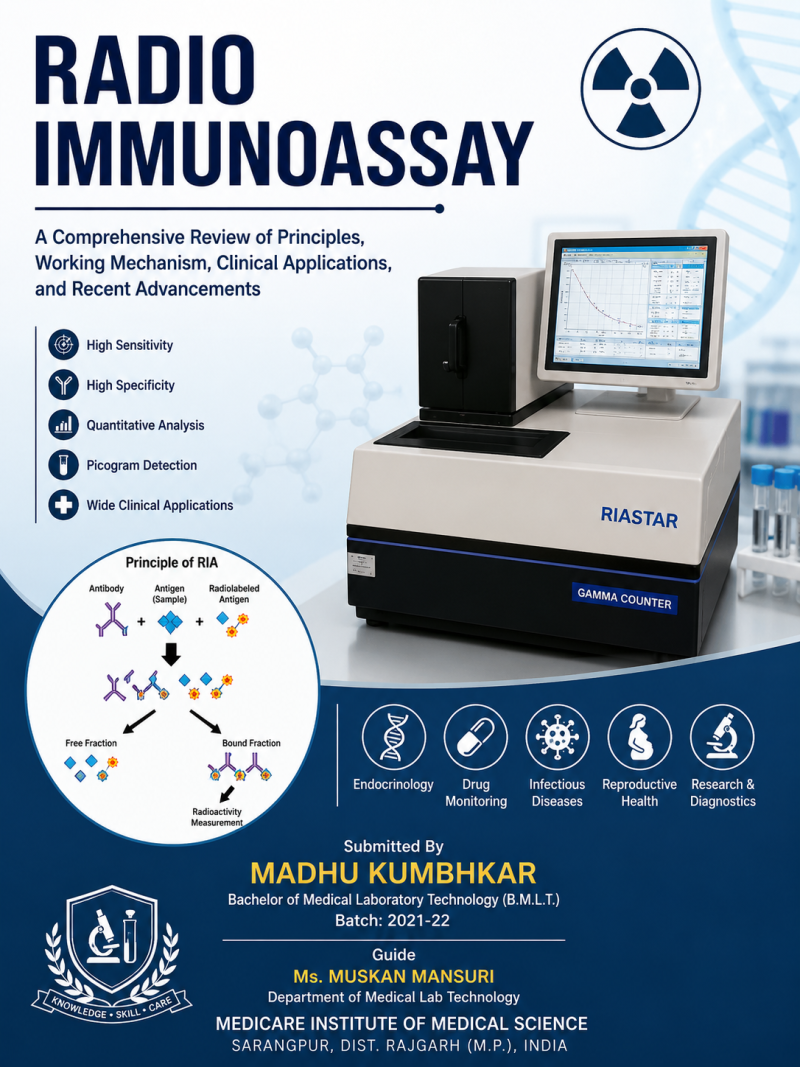
RADIO IMMUNONOASSY: A Comprehensive Review of Principles, Working Mechanism, Clinical Applications, and Recent Advancements
Keywords:
Radioimmunoassay (RIA), Immunoassay, Radiolabeled Antigen, Antigen-Antibody ReactionSynopsis
Radioimmunoassay (RIA) is a highly sensitive and specific laboratory technique used for the quantitative estimation of various biological substances such as hormones, drugs, enzymes, vitamins, and proteins present in very low concentrations. The technique is based on the principle of competitive binding between a radiolabeled antigen and an unlabeled antigen for a limited number of specific antibody binding sites. The amount of radioactivity measured is inversely proportional to the concentration of antigen present in the sample.
The present project provides a comprehensive overview of Radioimmunoassay, including its history, principles, components, working mechanism, procedure, applications, care and maintenance, specifications, and recent advancements. The development of RIA by Rosalyn S. Yalow and Solomon A. Berson revolutionized clinical diagnostics and earned worldwide recognition due to its exceptional accuracy and sensitivity in detecting substances at picogram levels.
RIA plays a significant role in clinical laboratories, endocrinology, pharmacology, immunology, nuclear medicine, and biomedical research. The Gamma Counter serves as the primary instrument used to measure the radioactivity emitted by radiolabeled compounds. Through competitive antigen-antibody reactions and precise radioactive measurements, RIA enables accurate diagnosis and monitoring of various diseases and physiological conditions.
Recent advancements in automation, microfluidic technology, multiplex assays, and improved detection systems have further enhanced the efficiency, sensitivity, and reliability of RIA. Although the use of radioactive materials requires strict safety measures and specialized equipment, RIA remains one of the most valuable analytical techniques in laboratory medicine. The study concludes that Radioimmunoassay continues to be an important diagnostic and research tool due to its high precision, specificity, and ability to detect extremely low concentrations of analytes.
Downloads
Download data is not yet available.
References
1. Textbook of medical laboratory technology Third edition Praful B. Godker and Darshan P. Godkar (2021)
2. Medical laboratory Science Theory & Practice J Ochei And A kolhatkar – 2000. 3. Textbook of microbiology 3rd edition, professor CP Baveja, publishing year 2016.
4. Essential Of Medical Microbiology Third edition Apurba Sastry and Sandhya 1990Bhat (2021).
5. Chard, T. Radioimmunoassay and Related Techniques. 2nd Edition.1990.
6. https://www.slideshare.net/slideshow/radioimmunoassay.
7. https://share. Google/B1A022TcEHW3lEXeG.
8. https://en.m.wikipedia.org/wiki/Rosalyn_Sussman_Yalow.
9. Creager, Angela. (2008). Molecular surveillance: A history of radioimmunoassays. Crafting Immunity: Working Histories of Clinical Immunology. 201-230.
10. https://www.sciencedirect.com/topics/medicine-and-dentistry/radioimmunoassay.
11. https://www.revvity.com/in-en/ask/radioimmunoassays.
12. Chard, T. (1990). An Introduction to Radioimmunoassay and Related Techniques. 4th Edition, Elsevier, Amsterdam.
13. https://www.slideshare.net/slideshow/radioimmunoassay-248464884/248464884.
14. Yalow, R.S., & Berson, S.A. (1960). Immunoassay of endogenous plasma insulin in man. Journal of Clinical Investigation, 39(7), 1157-1175.
Downloads
Published
June 9, 2026
Data Availability Statement
The data supporting the findings of this study are contained within the project report. No additional datasets were generated or analyzed during the current study. Further information may be obtained from the corresponding author upon reasonable request.
Copyright (c) 2026 Ms. Madhu Kumbhkar, Ms. Muskan Mansuri (Author)
License

This work is licensed under a Creative Commons Attribution-NonCommercial 4.0 International License.
All publications published by Research Edge and Publication (REP) are protected under applicable copyright and licensing policies. Authors retain copyright of their work while granting the publisher the right to publish, distribute, archive, index, and promote the material in print and digital formats. Unless otherwise stated, published content may be accessed, shared, and used for academic, educational, and non-commercial research purposes with proper attribution to the original author(s) and publisher.
Users may not reproduce, modify, redistribute, or use published materials for commercial purposes without prior written permission from the copyright holder and the publisher. Authors are responsible for ensuring that submitted content does not infringe upon any copyright, intellectual property rights, or third-party permissions.
Research Edge and Publication (REP) supports ethical scholarly communication, responsible knowledge sharing, and global academic accessibility through recognized open-access and licensing practices. Additional licensing conditions may apply depending on the publication model, author agreement, or specific publication requirements.
Details about this monograph
ISBN-13 (15)
978-81-687767-2-2
other::urn
urn:isbn:rep.12.122
How to Cite
KUMBHKAR , M. ., & Mansuri, M. (Eds.). (2026). RADIO IMMUNONOASSY: A Comprehensive Review of Principles, Working Mechanism, Clinical Applications, and Recent Advancements. Research Edge and Publication. https://books.researchedgeandpublication.com/index.php/REP/catalog/book/12