
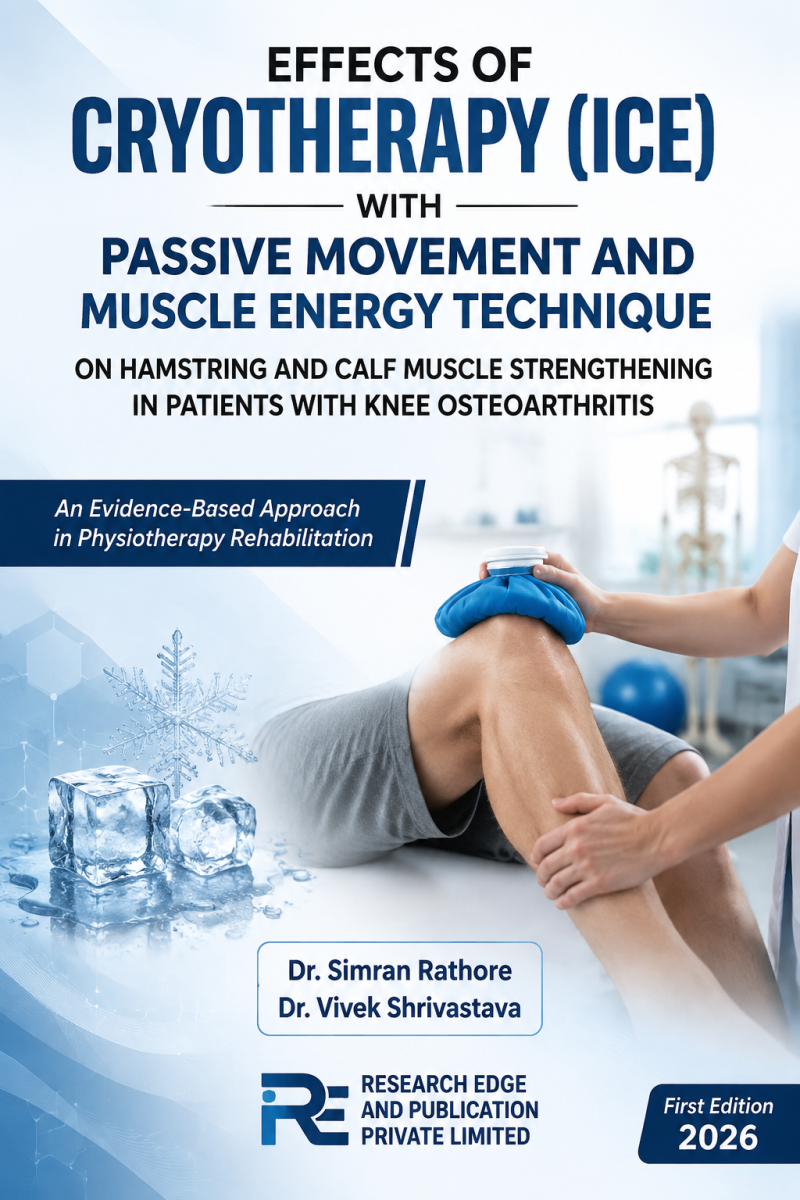
EFFECTS OF CRYOTHERAPY (ICE) WITH PASSIVE MOVEMENT AND MUSCLE ENERGY TECHNIQUE ON HAMSTRING AND CALF MUSCLE STRENGTHENING IN PATIENTS WITH KNEE OSTEOARTHRITIS
Keywords:
Knee osteoarthritis, cryotherapy, ice therapy, passive range of motion, muscle energy technique, hamstring, gastrocnemius, calf muscle, physiotherapy, musculoskeletal rehabilitationSynopsis
Background: Knee osteoarthritis (KOA) is a prevalent degenerative joint disease characterized by articular cartilage degradation, subchondral bone remodeling, synovial inflammation, and periarticular muscle weakness. The hamstring and calf (gastrocnemius-soleus complex) muscles play a critical biomechanical role in dynamic knee stabilization, and their atrophy significantly contributes to functional impairment and disease progression in KOA patients.
Objectives: This study aimed to investigate the combined effects of cryotherapy (ice application) with passive range-of-motion exercises and Muscle Energy Technique (MET) on hamstring and calf muscle strength, pain intensity, functional mobility, and joint range of motion in patients with Grade II–III knee osteoarthritis.
Methods: A randomized controlled trial (RCT) design was employed. Sixty participants (aged 45–70 years) diagnosed with KOA (Kellgren-Lawrence Grade II or III) were randomly allocated into three groups: Group A (Cryotherapy + Passive Movement + MET, n=20), Group B (Passive Movement + MET only, n=20), and Group C (conventional physiotherapy control, n=20). Interventions were administered for 6 weeks, three sessions per week. Primary outcome measures included muscle strength (Handheld Dynamometry), pain (Visual Analogue Scale), and functional performance (WOMAC Index, Timed Up and Go Test). Secondary outcomes included knee joint range of motion (goniometry) and quality of life (SF-36).
Results: Group A demonstrated statistically significant improvements across all outcome measures compared to Groups B and C (p < 0.001). Hamstring muscle strength increased by 42.3% in Group A, versus 28.7% in Group B and 14.5% in Group C. Calf muscle strength improved by 38.6%, 25.4%, and 11.2% in Groups A, B, and C respectively. Pain scores (VAS) decreased from a mean of 7.2 to 2.4 in Group A. WOMAC functional scores improved by 58.4% in Group A, 39.2% in Group B, and 21.7% in Group C. No adverse events were reported.
Conclusion: The combined application of cryotherapy with passive movement and Muscle Energy Technique produced superior outcomes in hamstring and calf muscle strengthening, pain reduction, and functional improvement compared to either technique alone or conventional physiotherapy. This multimodal approach represents an effective, safe, and clinically applicable intervention protocol for the conservative management of knee osteoarthritis.
Downloads
Download data is not yet available.
References
References are formatted in accordance with the American Physical Therapy Association (APTA) style based on the American Medical Association (AMA) Manual of Style.
1. Vos T, Flaxman AD, Naghavi M, et al. Years lived with disability (YLDs) for 1160 sequelae of 289 diseases and injuries 1990–2010: a systematic analysis for the Global Burden of Disease Study 2010. Lancet. 2012;380(9859):2163–2196.
2. Cross M, Smith E, Hoy D, et al. The global burden of hip and knee osteoarthritis: estimates from the Global Burden of Disease 2010 study. Ann Rheum Dis. 2014;73(7):1323–1330.
3. Silverwood V, Blagojevic-Bucknall M, Jinks C, et al. Current evidence on risk factors for knee osteoarthritis in older adults: a systematic review and meta-analysis. Osteoarthritis Cartilage. 2015;23(4):507–515.
4. Felson DT. Osteoarthritis as a disease of mechanics. Osteoarthritis Cartilage. 2013;21(1):10–15.
5. Slemenda C, Brandt KD, Heilman DK, et al. Quadriceps weakness and osteoarthritis of the knee. Ann Intern Med. 1997;127(2):97–104.
6. Hurley MV, Scott DL, Rees J, Newham DJ. Sensorimotor changes and functional performance in patients with knee osteoarthritis. Ann Rheum Dis. 1997;56(11):641–648.
7. Algafly AA, George KP. The effect of cryotherapy on nerve conduction velocity, pain threshold and pain tolerance. Br J Sports Med. 2007;41(6):365–369.
8. Bleakley CM, McDonough SM, MacAuley DC. The use of ice in the treatment of acute soft-tissue injury: a systematic review of randomized controlled trials. Am J Sports Med. 2004;32(1):251–261.
9. Brosseau L, Yonge KA, Robinson V, et al. Thermotherapy for treatment of osteoarthritis. Cochrane Database Syst Rev. 2003;(4):CD004522.
10. Mitchell FL Sr. Structural pelvic function. Academy of Applied Osteopathy Yearbook. 1958;2:71–90.
11. Mitchell FL Jr, Moran PS, Pruzzo NT. An Evaluation and Treatment Manual of Osteopathic Muscle Energy Procedures. Valley Park, MO: Mitchell, Moran, and Pruzzo Associates; 1979.
12. Fryer G. Muscle energy technique: An evidence-informed approach. Int J Osteopath Med. 2011;14(1):3–9.
13. Lenehan KL, Fryer G, McLaughlin P. The effect of muscle energy technique on gross trunk range of motion. J Osteopath Med. 2003;6(1):13–18.
14. Hoeksma HL, Dekker J, Ronday HK, et al. Comparison of manual therapy and exercise therapy in osteoarthritis of the hip: a randomized clinical trial. Arthritis Rheum. 2004;51(5):722–729.
15. Bennell KL, Egerton T, Martin J, et al. Effect of physical therapy on pain and function in patients with hip osteoarthritis: a randomized clinical trial. JAMA. 2014;311(19):1987–1997.
16. Fransen M, McConnell S, Harmer AR, Van der Esch M, Simic M, Bennell KL. Exercise for osteoarthritis of the knee. Cochrane Database Syst Rev. 2015;(1):CD004376.
17. Salter RB. The biologic concept of continuous passive motion of synovial joints. The first 18 years of basic research and its clinical application. Clin Orthop Relat Res. 1989;(242):12–25.
18. Kellgren JH, Lawrence JS. Radiological assessment of osteo-arthrosis. Ann Rheum Dis. 1957;16(4):494–502.
19. Bellamy N, Buchanan WW, Goldsmith CH, Campbell J, Stitt LW. Validation study of WOMAC: a health status instrument for measuring clinically important patient relevant outcomes to antirheumatic drug therapy in patients with osteoarthritis of the hip or knee. J Rheumatol. 1988;15(12):1833–1840.
20. Podsiadlo D, Richardson S. The timed 'Up & Go': a test of basic functional mobility for frail elderly persons. J Am Geriatr Soc. 1991;39(2):142–148.
21. Hopkins JT, Ingersoll CD. Arthrogenic muscle inhibition: a limiting factor in joint rehabilitation. J Sport Rehabil. 2000;9(2):135–159.
22. Rice DA, McNair PJ. Quadriceps arthrogenic muscle inhibition: neural mechanisms and treatment perspectives. Semin Arthritis Rheum. 2010;40(3):250–266.
23. Ware JE Jr, Sherbourne CD. The MOS 36-item short-form health survey (SF-36). I. Conceptual framework and item selection. Med Care. 1992;30(6):473–483.
24. Farrar JT, Young JP Jr, LaMoreaux L, Werth JL, Poole RM. Clinical importance of changes in chronic pain intensity measured on an 11-point numerical pain rating scale. Pain. 2001;94(2):149–158.
25. Pincus T, Koch G, Lei H, et al. Patient Preference for Placebo, Acetaminophen or Celecoxib Efficacy Studies (PACES): two randomised, double blind, placebo controlled, crossover clinical trials in patients with knee or hip osteoarthritis. Ann Rheum Dis. 2004;63(8):931–939.
26. Altman R, Asch E, Bloch D, et al. Development of criteria for the classification and reporting of osteoarthritis: classification of osteoarthritis of the knee. Arthritis Rheum. 1986;29(8):1039–1049.
27. Lin J, Zhang W, Jones A, Doherty M. Efficacy of topical non-steroidal anti-inflammatory drugs in the treatment of osteoarthritis: meta-analysis of randomised controlled trials. BMJ. 2004;329(7461):324.
28. Bijlsma JW, Berenbaum F, Lafeber FP. Osteoarthritis: an update with relevance for clinical practice. Lancet. 2011;377(9783):2115–2126.
29. McAlindon TE, Bannuru RR, Sullivan MC, et al. OARSI guidelines for the non-surgical management of knee osteoarthritis. Osteoarthritis Cartilage. 2014;22(3):363–388.
30. Konrad A, Tilp M. Increased range of motion after static stretching is not due to changes in muscle and tendon structures. Clin Biomech. 2014;29(6):636–642.
Downloads
Published
July 24, 2026
Data Availability Statement
The datasets generated and/or analyzed during the current study are not publicly available due to institutional and participant confidentiality considerations but are available from the corresponding author upon reasonable request.
Copyright (c) 2026 Dr. Simran Rathore, Dr. Vivek Shrivastava (Author)
License

This work is licensed under a Creative Commons Attribution-NonCommercial 4.0 International License.
All publications published by Research Edge and Publication (REP) are protected under applicable copyright and licensing policies. Authors retain copyright of their work while granting the publisher the right to publish, distribute, archive, index, and promote the material in print and digital formats. Unless otherwise stated, published content may be accessed, shared, and used for academic, educational, and non-commercial research purposes with proper attribution to the original author(s) and publisher.
Users may not reproduce, modify, redistribute, or use published materials for commercial purposes without prior written permission from the copyright holder and the publisher. Authors are responsible for ensuring that submitted content does not infringe upon any copyright, intellectual property rights, or third-party permissions.
Research Edge and Publication (REP) supports ethical scholarly communication, responsible knowledge sharing, and global academic accessibility through recognized open-access and licensing practices. Additional licensing conditions may apply depending on the publication model, author agreement, or specific publication requirements.
Details about this monograph
ISBN-13 (15)
978-81-687767-4-6
other::urn
urn:isbn:rep.13.132
How to Cite
Rathore, S. ., & Shrivastava, V. (Eds.). (2026). EFFECTS OF CRYOTHERAPY (ICE) WITH PASSIVE MOVEMENT AND MUSCLE ENERGY TECHNIQUE ON HAMSTRING AND CALF MUSCLE STRENGTHENING IN PATIENTS WITH KNEE OSTEOARTHRITIS. Research Edge and Publication. https://books.researchedgeandpublication.com/index.php/REP/catalog/book/13