
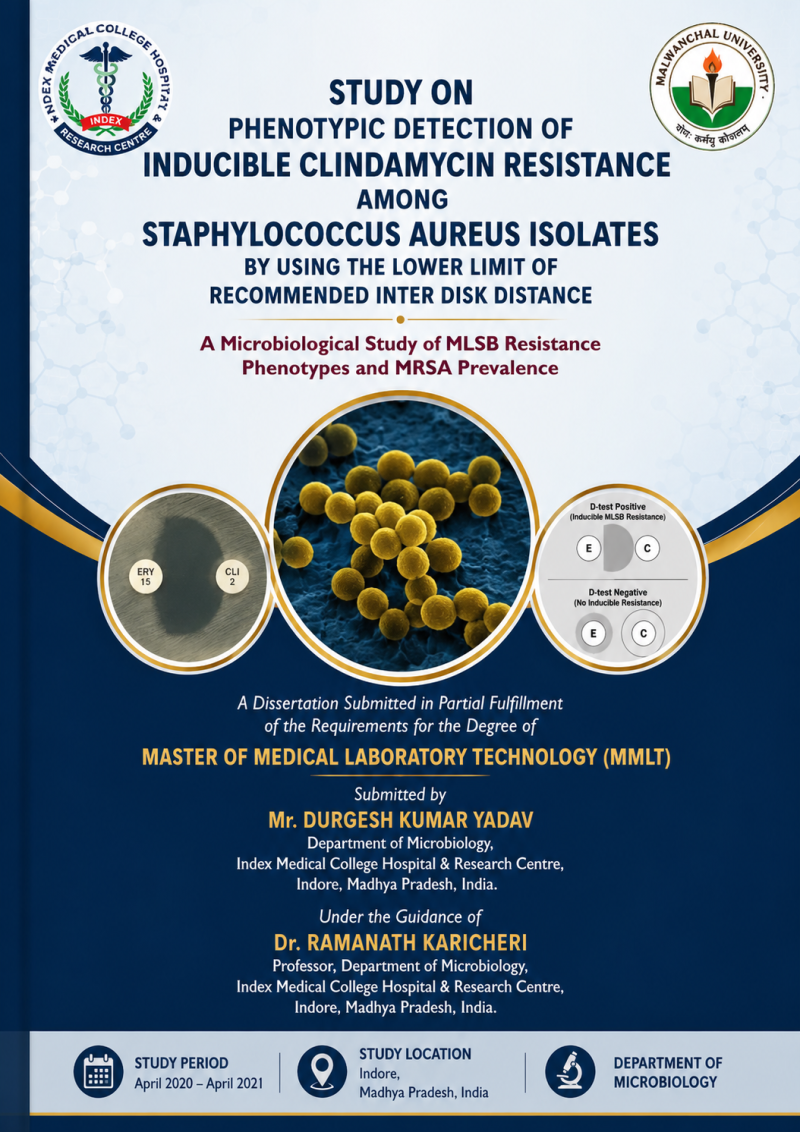
STUDY ON PHENOTYPIC DETECTION OF INDUCIBLE CLINDAMYCIN RESISTANCE AMONG STAPHYLOCOCCUS AUREUS ISOLATES BY USING THE LOWER LIMIT OF RECOMMENDED INTER DISK DISTANCE: A Microbiological Study of MLSB Resistance Phenotypes and MRSA Prevalence
##semicolon##
Staphylococcus aureus, Inducible Clindamycin Resistance, D-test, MRSA, MLSB Resistance, Phenotypic Detection##submission.synopsis##
Background:
Staphylococcus aureus is one of the most important human pathogens responsible for a wide range of community-acquired and hospital-acquired infections. The emergence of methicillin-resistant Staphylococcus aureus (MRSA) and inducible clindamycin resistance has become a major therapeutic challenge. Clindamycin is commonly used for the treatment of staphylococcal infections because of its excellent tissue penetration and oral bioavailability. However, inducible resistance mediated through the MLSB phenotype may result in treatment failure if not detected properly.
Aim and Objectives:
The present study was conducted to determine the prevalence of MRSA strains among clinical isolates of Staphylococcus aureus, to detect inducible clindamycin resistance by D-test using the lower limit of recommended inter-disk distance, and to evaluate the antibiotic resistance pattern of the isolates.
Materials and Methods:
This study was carried out in the Department of Microbiology, Index Medical College and Hospital, Indore, from April 2020 to April 2021. A total of 613 clinical samples including pus, urine, blood, sputum, and endotracheal aspirates were collected and processed by standard microbiological procedures. Identification of Staphylococcus aureus was done by Gram staining, catalase test, coagulase test, and mannitol fermentation test. Antibiotic susceptibility testing was performed by Kirby-Bauer disc diffusion method according to CLSI guidelines. Inducible clindamycin resistance was detected by D-test using erythromycin and clindamycin discs placed at 15 mm edge-to-edge distance.
Results:
Among the isolates of Staphylococcus aureus, varying resistance patterns to commonly used antibiotics were observed. The D-test identified inducible MLSB resistance among erythromycin-resistant and clindamycin-sensitive isolates. MRSA strains showed comparatively higher resistance rates than MSSA strains. Detection of inducible clindamycin resistance was found to be important for preventing therapeutic failure and guiding appropriate antibiotic therapy.
Conclusion:
Routine detection of inducible clindamycin resistance by D-test should be included in antimicrobial susceptibility testing of Staphylococcus aureus isolates. Early identification of MLSB resistance phenotypes helps clinicians in selecting appropriate antimicrobial therapy and reducing the spread of resistant strains.
##plugins.themes.default.displayStats.downloads##
##plugins.themes.default.displayStats.noStats##
##submission.citations##
1. Ryan KJ. Staphylococci. In: Ryan KJ, Ray CG, editors. Sherris medical microbiology, 4th ed. New York: McGraw Hill; 2004. p. 261-71.
2. Moreillon P, Que YA, Glauser MP. Staphylococcus aureus (including staphylococcal toxic shock). In: Mandell GL, Bennett JE, Dolin R, editors. Mandell, Douglas and Bennett’s Principles and practice of infectious diseases. 6th ed. Philadelphia: Elsevier Churchill Livingstone; 2005. p. 2321-51.
3. Fokas, S., Fokas, S., Tsironi, M., Kalkani, M. & Dionysopouloy, M. (2005). Prevalence of inducible clindamycin resistance in macrolide-resistant Staphylococcus spp. Clin Microbiol Infect 11, 337–340.
4. Hussain, F. M., Boyle-Vavra, S., Bethel, C. D. & Daum, R. S. (2000). Current trends in community-acquired methicillin-resistant Staphylococcus aureus at a tertiary care pediatric facility. Pediatr Infect Dis J 19, 1163–1166.
5. Groom, A. V., Wolsey, D. H., Naimi, T. S., Smith, K., Johnson, S., Boxrud, D., Moore, K. A. & Cheek, J. E. (2001). Community-acquired methicillin-resistant Staphylococcus aureus in a rural American Indian community. JAMA 286, 12011205.
6. Naimi, T. S., LeDell, K. H., Boxrud, D. J., Groom, A. V., Steward, C. D., Johnson, S. K., Besser, J. M., O'Boyle, C., Danila, R. N. & other authors (2001). Epidemiology and clonality of community-acquired methicillin-resistant Staphylococcus aureus: Minnesota, 1996–98. Clin Infect Dis 33, 990–996.
7. Fiebelkorn, K. R., Crawford, S. A., McElmeel, M. L. & Jorgensen, J. H. (2003). Practical disk diffusion method for detection of inducible clindamycin resistance in Staphylococcus aureus and coagulase-negative staphylococci. J Clin Microbiol 2003; 41: 4740–4744.
8. Barber M, Waterworth P. Antibacterial activity of lincomycin and pristamycin: a comparision with erythromycin. Br Med J. 1964;2: 603-606.
9. Martinez-Aguilar G, Hammerman W, Mason E Jr, et al. Clindamycin treatment of invasive infections caused by community-acquired, methicillinresistant and methicillin-susceptible Staphylococcus aureus in children. Pediatr Infect Dis J. 2003;22:593–598.
10. Frank AL, Marcinak J, Mangat P, et al. Clindamycin treatment of methicillin- resistant Staphylococcus aureus infections in children. Pediatr Infect Dis J. 2002;21:530 –534.
11. McGehee RF, Barrett F, Finland M. Resistance of Staphylococcus aureus to lincomycin, clinimycin, and erythromycin. Antimicrob Agents Chemother. 1968;8:392–397.
12. Sande M, Johnson M. Antimicrobial therapy of experimental endocarditis caused by Staphylococcus aureus. J Infect Dis. 1975;131:367–375.
13. Watanakunakorn C. Clindamycin therapy of Staphylococcus aureus endocarditis. Am J Med. 1976;60:419–425.
14. Siberry GK, Tekle T, Carroll K, Dick J. Failure of Clindamycin treatment of methicillin-resistant Staphylococcus aureus expressing inducible Clindamycin resistance in vitro. Clin Infect Dis 2003;37:1257-60.
15. B. Turng et al. Detection and Interpretation of Macrolide-LincosamideStreptogramin Resistance among Staphylococcus with Phoenix Automated Microbiology System and BDXpertTM System, as presented in 15th ECCMID, Copenhagen, 2005.
16. National Committee for Clinical Laboratory Standards. Methods for antimicrobial susceptibility testing for bacteria that grow aerobically; Fourteenth informational supplement. NCCLS document M100-S14. Wayne, Pennsylvania: National Committee For Clinical Laboratory Standards; 2004.
17. O’Sullivan MV, Cai Y, Kong F, Zeng X, Gilbert GL. Influence of disk separation distance on accuracy of the disk approximation test for detection of inducible Clindamycin resitance in Staphylococcus spp. J Clin Microbiol 2006;44:4072-6.
18. Sharon J, Peacock. Staphylococcus In: Topley and Wilson’s Microbiology and Microbial infections, Bacteriology, Vol-2. 10th ed. Pg No-.771-832.
19. J. G. Collee, A. G. Fraser, B.P. Marmion, A. Simmons. Mackie and Mac Cartney. Practical Medical Microbiology. 14th ed. Pg No- .245-261.
20. Drincovic D, Fuller, Shore KP, Holland DJ et al. Clindamycin treatment of staphylococcus aureus expressing inducible clindamycin resistance. J Antimicrob chemother 2001; 48: 315-6.
21. Lewis JS, Jorgenson JH. Inducible clindamycin resistance in Staphylococci: should clinicians and microbiologists be concerned? Clin Infect Dis 2005; 40: 280-5.
22. Loclercq R. Mechanisms of resistance to macrolide and lincosamides: Nature of the resistance elements and their clinical implications. Clin Infect Dis 2002;34:48292.
23. KD Tripathi. Essentials of Medical Pharmacology, 6th edition: Page no. 727-732.
24. Sivapalasingam S, Steigbigel NH. Macrolides, clindamycin and ketolides. In: Mandell GL, Bennett JE, Dolin R, editors. Mandell, Douglas and Bennett’s Principles and practice of infectious diseases. 6th ed. Philadelphia: Elsevier Churchill Livingstone; 2005. p. 410-7.
25. Mohanasoundaram K M. The Prevalence of Inducible Clindamycin Resistance among Gram Positive cocci from various clinical specimens. Journal of Clinical and Diagnostic Research. 2011 Feb, Vol-5(1):38-40.
26. Stevens DL, Ma Y, Salmi D, et al. Impact of antibiotics on expression of virulenceassociated exotoxin genes. J Infect Dis. 2007;195: 202-211.
27. Charles R. Woods et al. Macrolide-Inducible Resistance to Clindamycin and the D-test. Pediatr Infect Dis J 2009;28: 1115-1118.
28. Goldman, R. C. & Capobianco, J. O. (1990). Role of an energy-dependent efflux pump in plasmid pNE24-mediated resistance to 14- and 15-membered macrolides in Staphylococcus epidermidis. Antimicrob Agents Chemother 34, 1973–1980.
29a. Leclercq, R. & Courvalin, P. (1991a). Bacterial resistance to macrolide, lincosamide, and streptogramin antibiotics by target modification. Antimicrob Agents Chemother 35, 1267–1272.
29b. Leclercq, R. & Courvalin, P. (1991b). Intrinsic and unusual resistance to macrolide, lincosamide, and streptogramin antibiotics in bacteria. Antimicrob Agents Chemother 35, 1273–1276.
30. Weisblum B. Erythromycin resistance by ribosome modification. Antimicrob Agents Chemother 1995;39:577-85.
31. Roberts MC, Sutcliffe J, Courvalin P, Jensen LB, Rood J, Seppala H. Nomenclature for macrolide and macrolide-lincosamide-streptogramin B resistance determinants. Antimicrob Agents Chemother 1999;43:2823-30
32. Weisblum B, Demohn V. Erythromycin-inducible resistance in Staphylococcus aureus : Survey of antibiotic classes involved. J Bacteriol 1969;98:447-52.
33. Weisblum, B. 1995. Insights into erythromycin action from studies of its activity as inducer of resistance. Antimicrob Agents Chemother39:797-805.
34. Schmitz, F.-J., J. Petridou, A. C. Fluit, U. Hadding, G. Peters, and C. von Eiff. 2000. Distribution of macrolide-resistant genes in Staphylococcus aureus bloodculture isolates from fifteen German university hospitals. Eur. J. Clin. Microbiol. Infect. Dis. 19:385-387.
35. Roberts, M. C., Sutcliffe, J., Courvalin, P., Jensen, L. b., Rood, J. and Seppala, H. (1999): Nomenclature for macrolide-lincosamide-streptogramin B resistance determinants. Antimicrob. Agents Chemother., 43, 2823-2830.
36. Jenssen, W. D., Thakker-Varia, S., Dubin, D. T. And Weinstein, M. P. (1987): Prevalence of macrolides-lincosamides-streptogramins B resistance and erm gene classes among clinical strains of staphylococci and streptococci. Antimicrob. Agents Chemother., 31, 883-888.
37. Dubnau D. Translational attenuation: the regulation of bacterial resistance. CRC Crit Rev Biochem. 1984;16:103–132.
38. Vazquez-Laslop N, Thum C, Mankin A. Molecular mechanism of drug dependent ribosome stalling. Mol Cell. 2008;30:190 –202.
39. Steward CD, Raney P, Morrell A, et al. Testing for induction of clindamycin resistance in erythromycin-resistant isolates of Staphylococcus aureus. J Clin Microbiol. 2005;43:1716 –1721.
40. National Committee for Clinical Laboratory Standards. Performance standards for antimicrobial susceptibility testing; 12th informational supplement. NCCLS document M100-S14. Wayne, PA: NCCLS; 2004.
41. National Committee for Clinical Laboratory Standards-NCCLS. Performance standards for antimicrobial disc susceptibility tests. M100-S14. Wayne, PA: National Committee for Clinical Laboratory Standards; 2004.
42. Sureerat Chelae, Varaporn Laohaprertthisarn et al. Detection of Inducible Clindamycin Resistance in Staphylococci by Disk Diffusion Induction Test. J Med Assoc Thai 2009; 92 (7): 947-51.
43. Zorgani A, Shawerf O, Tawil K, El-Turki E and Ghenghesh KS. Inducible Clindamycin Resistance among Staphylococci isolated from burn patients. LJM DOI: 10.4176/090128.
44. S.E.Mshana, E. Kamugisha, M. Mirambo, P. Chalya, P. Rambau, W. Mahalu and E. Lyamuya. Prevalence of clindamycin resistance among methicillin-resistant Staphylococcus aureus at Bugando Medical Centre, Mwanza, Tanzania. Tanzania J of Health Research 2009; Vol 11, No 2: Page No: 59-64.
45. MR Angel, V Balaji, JAJ Prakash, KN Brahmadathan, MS Mathews. Prevalence of inducible clindamycin resistance in gram positive organisms in a tertiary care centre. IJMM 2008; 26(3): 262-64.
46. Nuran Delialioglu, Gonul Aslan, Candan Ozturk, Vildan Baki, Sebahat Sen and Gurol Emekdas. Inducible clindamycin resistance in Staphylococci isolated from clinical samples. Jpn. J. Infect. Dis., 58, 104-106, 2005.
47. National Committee for Clinical Laboratory Standards-NCCLS. Performance standards for antimicrobial disc susceptibility tests, fourteenth informational supplement, document M100-S14. Wayne, PA: National Committee for Clinical Laboratory Standards; 2004.
48. Rao, G.G. (2000) should clindamycin be used in treatment of patients with infections caused by erythromycin-resistant staphylococci? J antimicrob Chemother 45, 715.
##submission.downloads##
##catalog.published##
जून 1, 2026
##submission.dataAvailability##
The data used in this study were collected and analyzed during the current research work at the Department of Microbiology, Index Medical College Hospital & Research Centre, Indore. The datasets generated and analyzed during the study are available from the corresponding author upon reasonable academic request.
##submission.copyrightStatement##
##submission.license##
##submission.license.cc.by-nc4.footer##All publications published by Research Edge and Publication (REP) are protected under applicable copyright and licensing policies. Authors retain copyright of their work while granting the publisher the right to publish, distribute, archive, index, and promote the material in print and digital formats. Unless otherwise stated, published content may be accessed, shared, and used for academic, educational, and non-commercial research purposes with proper attribution to the original author(s) and publisher.
Users may not reproduce, modify, redistribute, or use published materials for commercial purposes without prior written permission from the copyright holder and the publisher. Authors are responsible for ensuring that submitted content does not infringe upon any copyright, intellectual property rights, or third-party permissions.
Research Edge and Publication (REP) supports ethical scholarly communication, responsible knowledge sharing, and global academic accessibility through recognized open-access and licensing practices. Additional licensing conditions may apply depending on the publication model, author agreement, or specific publication requirements.
##monograph.miscellaneousDetails##
ISBN-13 (15)
978-81-687767-0-8
other::urn
urn:isbn:rep.10.110
##submission.howToCite##
Yadav, D. K., & Karicheri, R. (Eds.). (2026). STUDY ON PHENOTYPIC DETECTION OF INDUCIBLE CLINDAMYCIN RESISTANCE AMONG STAPHYLOCOCCUS AUREUS ISOLATES BY USING THE LOWER LIMIT OF RECOMMENDED INTER DISK DISTANCE: A Microbiological Study of MLSB Resistance Phenotypes and MRSA Prevalence: Vol. BOOK 1 Volume 1. Research Edge and Publication. https://books.researchedgeandpublication.com/index.php/REP/catalog/book/10