
Flame Photo Meter
##semicolon##
Flame Photometer, Flame Emission Spectroscopy, Alkali Metals, Sodium Analysis, Potassium Analysis, Lithium Detection, Atomic Emission, Clinical Biochemistry, Electrolyte Analysis, Instrumentation, Nebulizer##submission.synopsis##
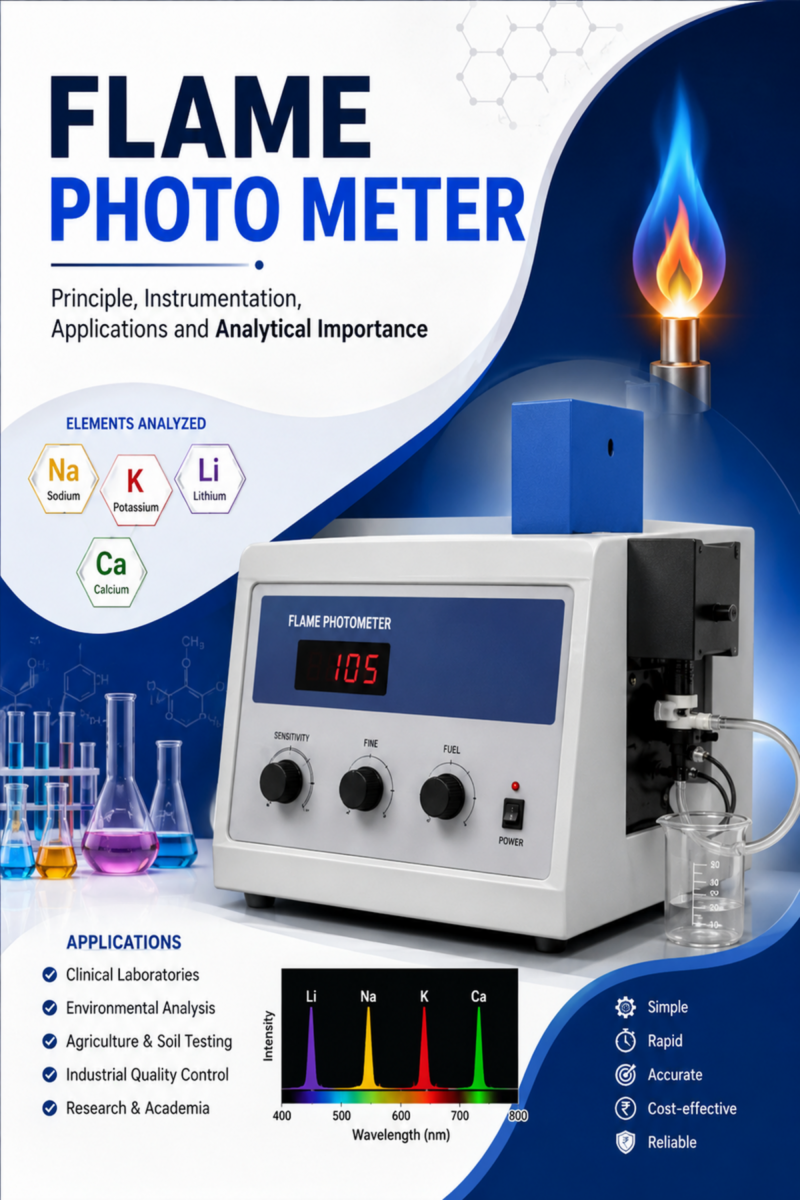
Flame photometry is an analytical technique widely used for the qualitative and quantitative determination of alkali and alkaline earth metals such as sodium, potassium, lithium, and calcium. The present project provides a detailed study of the flame photometer, including its principle, components, working procedure, applications, maintenance, and recent advancements. The instrument works on the principle that metal ions, when introduced into a flame, absorb thermal energy and emit light at characteristic wavelengths. The intensity of the emitted light is directly proportional to the concentration of the element present in the sample.
This project explains the major components of the flame photometer such as burner, nebulizer, monochromator, detector, and readout system, along with their individual functions in the analytical process. The working procedure and calibration methods used for accurate estimation of metal ions have also been discussed. Flame photometry is widely applied in clinical laboratories for electrolyte analysis, in environmental studies for water and soil testing, in agriculture for fertilizer analysis, and in industrial laboratories for quality control.
The project also highlights the advantages of flame photometry including simplicity, rapid analysis, cost-effectiveness, and good sensitivity for selected elements. Limitations such as interference effects and restricted elemental analysis have also been described. Recent advancements like digital integration, automation, portable instruments, and multi-element analysis have improved the efficiency and accuracy of flame photometers.
Overall, flame photometry remains an important analytical tool in modern laboratories due to its reliability, precision, and broad range of applications in medical, environmental, agricultural, and industrial fields.
##plugins.themes.default.displayStats.downloads##
##plugins.themes.default.displayStats.noStats##
##submission.citations##
Textbook of medical laboratory technology Third edition Praful B. Godkar and Darshan P Godkar (2021)
Medical laboratory Science Theory & Practice J Oches And A kolhatkar-2000.
Cengage Learning. 7th edition Skoog. D.A. Holler. F. J. & Crouch, S. R. (2017). Principles of Instrumental Analysis.
Principles and Techniques of Biochemistry and Molecular Biology Seventh edition, Keith Wilson And John Walker 2010.
https://www.sciencedirect.com/science/article/abs/pii/S030090842200003X
https://www.asceessingscoreinglibrary.com/content/book/978007060460/chapter/chapter4
Handbook of analytical instruments 2nd edition,Dr.R.SKhandpur,2006.
Handbook of optics instruments 3rd edition, professor Michal Bass ,2010.
https://books.google.co.in/books/about/Flame_Photometry.html?id=LTcLAQAAIAAJ&redir_esc=y
https://pmc.ncbi.nlm.nih.gov/articles/PMC6816826/ J Clin Lab Anal. 2018 Jun 19;32(9):e2594. Doi: 10.1002/jcla.22594.
https://www.slideshare.net/slideshow/flame-photometry-236318924/236318924
Practical clinical Biochemistry method and interpretation,4th edition, professor Ranjana Chawla.2000.
https://www.slideshare.net/slideshow/flame-photometry-236318924/236318924
Clinical Laboratory Standards Institute (CLSI).
CLSI documents provide guidelines for electrolyte analysis in clinical specimens, describing the application of flame photometry in medical diagnostics.
Scientific Articles and Reviews on Flame Photometry. Journals such as Analytical Chemistry, Talanta, and Journal of Analytical Atomic Spectrometry publish research articles detailing improvements in flame photometry sensitivity, multi-element analysis, and applications in environmental and clinical fields.
Christian, G. D. (2004). Analytical Chemistry (6th ed.). John Wiley & Sons This book discusses the instrumentation and methodology for elemental analysis, including flame photometry’s role, sample preparation, and instrumental specifications.
##submission.downloads##
##catalog.published##
जून 1, 2026
##submission.dataAvailability##
No external dataset was used in this study. All information included in this work is based on standard textbooks, reference materials, and published scientific literature related to flame photometry and laboratory instrumentation.
##submission.copyrightStatement##
##submission.license##
##submission.license.cc.by-nc4.footer##All publications published by Research Edge and Publication (REP) are protected under applicable copyright and licensing policies. Authors retain copyright of their work while granting the publisher the right to publish, distribute, archive, index, and promote the material in print and digital formats. Unless otherwise stated, published content may be accessed, shared, and used for academic, educational, and non-commercial research purposes with proper attribution to the original author(s) and publisher.
Users may not reproduce, modify, redistribute, or use published materials for commercial purposes without prior written permission from the copyright holder and the publisher. Authors are responsible for ensuring that submitted content does not infringe upon any copyright, intellectual property rights, or third-party permissions.
Research Edge and Publication (REP) supports ethical scholarly communication, responsible knowledge sharing, and global academic accessibility through recognized open-access and licensing practices. Additional licensing conditions may apply depending on the publication model, author agreement, or specific publication requirements.
##monograph.miscellaneousDetails##
ISBN-13 (15)
978-81-996766-9-5
other::urn
urn:isbn:rep.9.94
##submission.howToCite##
Vinayak Namdev, & Patidar, K. (Eds.). (2026). Flame Photo Meter. Research Edge and Publication. https://books.researchedgeandpublication.com/index.php/REP/catalog/book/9