
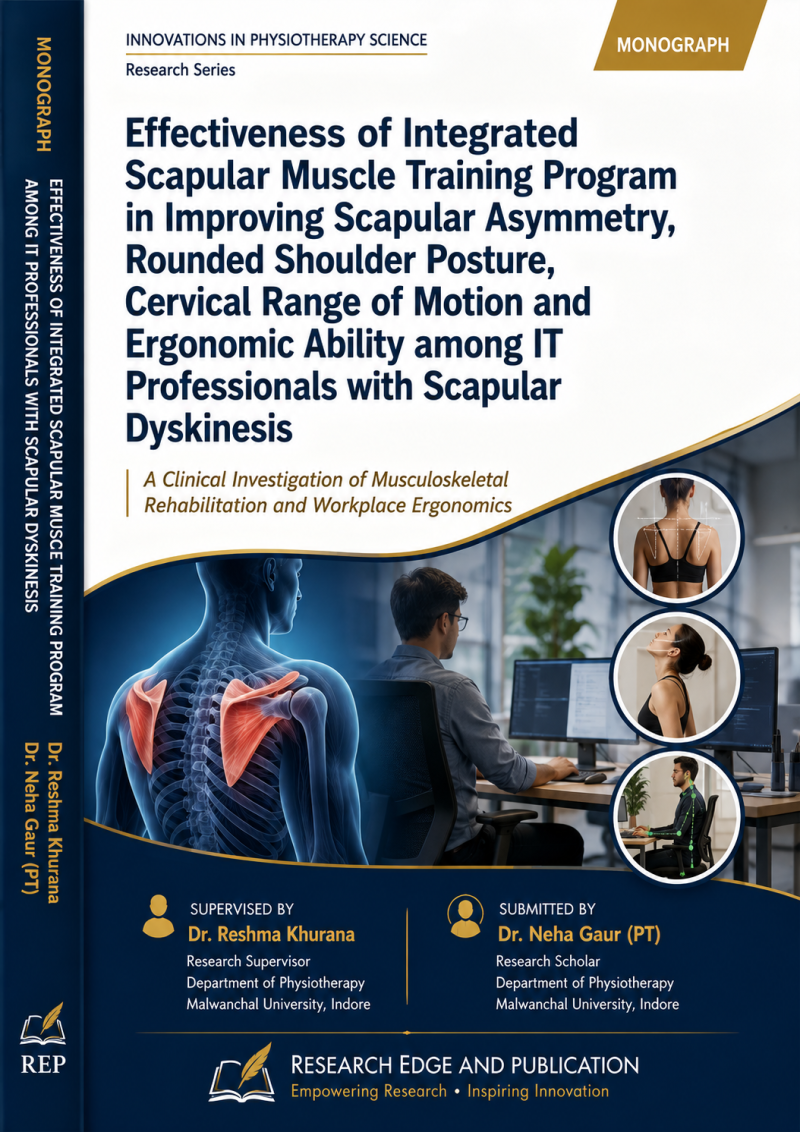
Effectiveness of Integrated Scapular Muscle Training Program in Improving Scapular Asymmetry, Rounded Shoulder Posture, Cervical Range of Motion and Ergonomic Ability among IT Professionals with Scapular Dyskinesis: A Clinical Investigation of Musculoskeletal Rehabilitation and Workplace Ergonomics
Keywords:
Scapular Dyskinesis, Scapular Muscle Training, Scapular Asymmetry, Rounded Shoulder Posture, Cervical Range of Motion, Ergonomic Ability, IT Professionals, Scapular Stabilization, Workplace Ergonomics, Musculoskeletal DisordersSynopsis
This study aimed to assess the effectiveness of an Integrated Scapular Muscle Training Program for IT workers with scapular dyskinesis. One hundred and fifty participants were selected and randomly assigned to an experimental and a control group. Structured scapular muscle training program was given to the experimental group for 6-8 weeks, whereas the control group continued their routine activities. Scapular asymmetry was assessed using the Lateral Scapular Slide Test (LSST), rounded shoulder posture was evaluated through the table to acromion distance method, cervical range of motion was measured with a universal goniometer and ergonomic ability was evaluated with RULA and ROSA scores. The findings of the study showed that all the outcome variables improved significantly in the experimental group (p < 0.001) and did not improve in the control group. There was also a strong correlation between scapular stability and ergonomic risk score. The study findings conclude that the Integrated Scapular Muscle Training Program can be effective in enhancing posture, mobility and ergonomic function among IT workers.
Downloads
Download data is not yet available.
References
1. Sullivan, S. E., & Mainiero, L. A. (2007). The changing nature of gender roles, alpha/beta careers and work- life issues. Career Development International, 12(3), 238–263. https://doi.org/10.1108/13620430710745881
2. Society, I. C. (1979). Exploding technology, responsible growth: Digest of Papers.
3. Sauter, S., Brightwell, W., Niosh, M. C., Hurrell, J., Niosh, T., Katz, N., David, E., Legrande, Lessin, N., Lippin, R., Meddac, U., Lipscomb, J., Murphy, L., Niosh, R. P., Keita, G. P., Robertson, S., Stellman, J., Swanson, N., Lois, N., . . . Peck, J. (2002). The changing organization of work and the safety and health of working people: knowledge gaps and research directions.https://doi.org/10.26616/nioshpub2002116
4. Patel, V., Chesmore, A., Legner, C. M., & Pandey, S. (2021). Trends in workplace wearable technologies and Connected- Worker solutions for Next- Generation occupational safety, health, and productivity. Advanced Intelligent Systems, 4(1). https://doi.org/10.1002/aisy.202100099
5. Odebiyi, D. O., & Okafor, U. a. C. (2023). Musculoskeletal disorders, workplace ergonomics and injury Prevention. In IntechOpen eBooks. https://doi.org/10.5772/intechopen.106031
6. Shah, Y. K. (2017). The effects of myofascial manual therapy on muscle activity and blood flow in people with low back pain. In Kent Academic Repository (University of Kent). https://kar.kent.ac.uk/80097/1/56Thesis_1.5.4.1.pdf
7. Maggiano, C. (2012). Histomorphometry of humeral primary bone: Evaluating the endosteal lamellar pocket as an indicator of modeling drift in archaeological and modern skeletal samples. OhioLink ETD Center (Ohio Library and Information Network). http://rave.ohiolink.edu/etdc/view?acc_num=osu1338414475
8. Cailliet, R. (1980). The shoulder in hemiplegia.
9. Everett, T., & Kell, C. (2010). Human movement: An Introductory Text. Elsevier Health Sciences.
10. Varnell, M. (2015). The evaluation of scapular kinematics and muscular characteristics of the scapular stabilizers in overhead athletes presenting with scapular dyskinesis compared to healthy controls. D-Scholarship@Pitt (University of Pittsburgh). http://dscholarship.pitt.edu/25861/1/VarnellMS_ETD2015.pdf
11. Sciascia, A., & Kibler, W. B. (2022). Current Views of Scapular Dyskinesis and its Possible Clinical Relevance. International Journal of Sports Physical Therapy, 17(2), 117–130. https://doi.org/10.26603/001c.31727
12. Wilkinson, M. T. (2008). Three-dimensional geometry of a pterosaur wing skeleton, and its implications for aerial and terrestrial locomotion. Zoological Journal of the Linnean Society, 154(1), 27–69. https://doi.org/10.1111/j.1096-3642.2008.00409.x
13. Moroder, P., Minkus, M., Böhm, E., Danzinger, V., Gerhardt, C., & Scheibel, M. (2017). Use of shoulder pacemaker for treatment of functional shoulder instability. ObereExtremität, 12(2), 103–108. https://doi.org/10.1007/s11678-017-0399-z
14. Biafore, C. L. (2017). The effects of a specific exercise program on shoulder function for breast cancer survivors, 6-9 months Post-Surgery. In YorkSpace (York University). http://hdl.handle.net/10315/34567
15. Cole, B. J., &Chahla, J. (2022). Surgical Techniques of the Shoulder, elbow, and Knee in Sports Medicine, E-Book. Elsevier Health Sciences.
16. Smith, G. W., & Robinson, R. A. (1958). The treatment of certain Cervical-Spine disorders by anterior removal of the intervertebral disc and interbody fusion. Journal of Bone and Joint Surgery, 40(3), 607–624. https://doi.org/10.2106/00004623-195840030-00009
17. Neumann, W. P., Winkelhaus, S., Grosse, E. H., & Glock, C. H. (2020). Industry 4.0 and the human factor – A systems framework and analysis methodology for successful development. International Journal of Production Economics, 233, 107992. https://doi.org/10.1016/j.ijpe.2020.107992
18. O’Reilly, M., Finder, B., & Werrell, M. K. (2007). An Ergonomics Guide to computer workstations. AIHA.
19. Duncan, T. L. (1996). An evaluation of the Rapid Upper limb Assessment (RULA) method for use by non-ergonomists in supervisory positions in industry.
20. Throckmorton, T. (2023). Physical medicine and rehabilitation clinics, an issue of physical medicine and rehabilitation clinics of North America. Elsevier.
21. Leong, H. T. (2016). The Effects of Scapular Muscle Strength, Muscle Stiffness, and Coordination on Scapular Kinematics and Subacromial Space in Overhead Athletes with Rotator Cuff Tendinopathy.
22. Schydlowsky, P., Szkudlarek, M., & Madsen, O. R. (2022). Comprehensive supervised heavy training program versus home training regimen in patients with subacromial
impingement syndrome: a randomized trial. BMC Musculoskeletal Disorders, 23(1), 52. https://doi.org/10.1186/s12891-021-04969-0
23. Dawson, E. C. R. (2004). The relationship of stress levels to wellness practices among community college presidents. Digital Commons - East Tennessee State University (East Tennessee State University). https://dc.etsu.edu/etd/859
24. Kibler, W. B., & Sciascia, A. D. (2017). Disorders of the scapula and their role in shoulder injury: A Clinical Guide to Evaluation and Management. Springer.
25. Prentice, W. E. (1999). Rehabilitation techniques in sports medicine. McGraw-Hill Companies.
26. Korhan, O. (2010). WORK-RELATED MUSCULOSKELETAL DISORDERS DUE TO
COMPUTER USE: A Literature Review. LAP Lambert Academic Publishing.
27. Duncan, T. L. (1996b). An evaluation of the Rapid Upper limb Assessment (RULA) method for use by non-ergonomists in supervisory positions in industry.
28. Paulson, G. (2017). The effects of a shoulder strengthening program on scapular positioning in collegiate swimmers.
29. Gunderson, S. R. (2015). The effects of a five-week exercise intervention using EMG biofeedback on scapular stabilizer muscle activation and scapular kinematics.
30. Alizadeh, M. (2019). The development of EMG- Assisted Cervical Spine Biomechanical model.
31. Sattasuk, W., Sitilertpisan, P., Joseph, L., Paungmali, A., &Pirunsan, U. (2021). A clinical evaluation of scapular dyskinesis among professional bus drivers with unilateral upper quadrant musculoskeletal pain. Workplace Health & Safety, 69(10), 460–466. https://doi.org/10.1177/21650799211003562
32. Pires, L., Santos, N., Lana, J. V., De Macedo, A. P., Costa, F. R., Azzini, G. O. M., Mosaner, T., De Moraes Ferreira Jorge, D., Santos, G. S., Medeiros, A., Pereira, J. a. R., & Lana, J. F. (2024). Upper Crossed Syndrome and Scapulae Upper-Trapping: A mesotherapy protocol in cervicoscapulobrachial Pain—The 8:1 block. Bioengineering, 11(11), 1142. https://doi.org/10.3390/bioengineering11111142
33. Tasker, M. B. (2025). A comparison of spinal curvatures and posture between active kayakers and physically active non-kayakers. https://doi.org/10.51415/10321/6134
34. Hoijtink, H. (2011). Informative hypotheses: Theory and Practice for Behavioral and Social Scientists. CRC Press.
35. Borstad, J. D. (2004). The effect of pectoralis minor resting length variability on scapular kinematics.
36. Jiran, K., & St Catherine, C. O. (1994). Normative values for the lateral scapular slide test used to evaluate shoulder girdle stability.
37. Li, Y. (2024). Model based work assessment: Combining spatial and temporal modeling for structured proactive work analysis. Deep Blue (University of Michigan). https://doi.org/10.7302/22889
38. Colim, A., Pereira, D., Lima, P., Cardoso, A., Almeida, R., Fernandes, D., Mould, S., &Arezes, P. (2023). Designing a User-Centered Inspection Device’s handle for the aircraft manufacturing industry. Applied Sciences, 13(20), 11584. https://doi.org/10.3390/app132011584
39. Chaitow, L. (2013). Muscle energy techniques: with access to www.chaitowmuscleenergytechniques.com. Elsevier Health Sciences.
40. Sawyer, K. B. (1995). Relationship between scapular position and scapular muscle force after a strengthening program for scapular retraction.
41. Dergaa, I., Saad, H. B., Omri, A. E., Glenn, J., Clark, C., Washif, J., Guelmami, N., Hammouda, O., Al-Horani, R., Reynoso-Sánchez, L., Romdhani, M., Paineiras-Domingos, L., Vancini, R., Taheri, M., Mataruna-Dos-Santos, L., Trabelsi, K., Chtourou, H., Zghibi, M., Eken, Ö., . . . Chamari, K. (2023). Using artificial intelligence for exercise prescription in personalised health promotion: A critical evaluation of OpenAI’s GPT-4 model. Biology of Sport, 41(2), 221–241. https://doi.org/10.5114/biolsport.2024.133661
42. Wang, S., Teng, C., & Lin, K. (2004). Measurement of cervical range of motion pattern during cyclic neck movement by an ultrasound-based motion system. Manual Therapy, 10(1), 68–72. https://doi.org/10.1016/j.math.2004.08.009
43. Martin, R. M., & Fish, D. E. (2007). Scapular winging: anatomical review, diagnosis, and treatments. Current Reviews in Musculoskeletal Medicine, 1(1), 1–11. https://doi.org/10.1007/s12178-007-9000-5
44. Thigpen, C. A. (2006). Effects of forward head and rounded shoulder posture on scapular kinematics, muscle activity, and shoulder coordination.
45. Firouzjah, M. H., Firouzjah, E. M. a. N., & Ebrahimi, Z. (2023). The effect of a course of selected corrective exercises on posture, scapula-humeral rhythm and performance of adolescent volleyball players with upper cross syndrome. BMC Musculoskeletal Disorders, 24(1), 489. https://doi.org/10.1186/s12891-023-06592-7
46. Alizadeh, M. (2019b). The development of EMG- Assisted Cervical Spine Biomechanical model.
47. Almhdawi, K. A., Alrabbaie, H., Kanaan, S. F., Alahmar, M. R., Oteir, A. O., Mansour,
Z. M., & Obeidat, D. S. (2021). The prevalence of upper quadrants work-related musculoskeletal disorders and their predictors among registered nurses. Work, 68(4), 1035–1047. https://doi.org/10.3233/wor-213434
48. Lännergren, J., Westerblad, H., & Flock, B. (1990). Transient appearance of vacuoles in fatigued Xenopus muscle fibres. Acta Physiologica Scandinavica, 140(3), 437–445. https://doi.org/10.1111/j.1748-1716.1990.tb09019.x
49. Medicine, I. O., Council, N. R., Education, C. O. B. a. S. S. A., & Workplace, P. O. M. D.
a. T. (2001). Musculoskeletal disorders and the workplace: Low Back and Upper Extremities. National Academies Press.
50. Humphrey, D. R., & Freund, H. (1991). Motor control: Concepts and Issues.
51. Morris, M. E. (2000). Movement Disorders in People with Parkinson Disease: a model for physical therapy. Physical Therapy, 80(6), 578–597. https://doi.org/10.1093/ptj/80.6.578
52. Laeser, K. L. (1997). The effect of computer Workstation design on student posture and computer task performance: Children Grades Six and Eight.
53. Kibler, W. B., & Sciascia, A. D. (2017). Disorders of the scapula and their role in shoulder injury: A Clinical Guide to Evaluation and Management. Springer.
54. Østensvik, T., Veiersted, K. B., & Nilsen, P. (2007). A method to quantify frequency and duration of sustained low-level muscle activity as a risk factor for musculoskeletal discomfort. Journal of Electromyography and Kinesiology, 19(2), 283–294. https://doi.org/10.1016/j.jelekin.2007.07.005
55. Vos, T., Abajobir, A. A., Abate, K. H., Abbafati, C., Abbas, K. M., Abd-Allah, F.,
Abdulkader, R. S., Abdulle, A. M., Abebo, T. A., Abera, S. F., Aboyans, V., Abu-Raddad, L. J., Ackerman, I. N., Adamu, A. A., Adetokunboh, O., Afarideh, M., Afshin, A., Agarwal, S. K., Aggarwal, R., . . . Bhala, N. (2017). Global, regional, and national incidence, prevalence, and years lived with disability for 328 diseases and injuries for 195 countries, 1990–2016: a systematic analysis for the Global Burden of Disease Study 2016. The Lancet, 390(10100), 1211–1259. https://doi.org/10.1016/s0140-
6736(17)32154-2
56. Gencturk, S., & Unal, G. (2024). Rodent tests of depression and anxiety: Construct validity and translational relevance. Cognitive Affective &Behavioral Neuroscience, 24(2), 191–224. https://doi.org/10.3758/s13415-024-01171-2
57. Merskey, H. (1994). Classification of chronic pain: Descriptions of chronic pain syndromes and definitions of pain terms.
58. Bartz, R. (1999). Beyond the biopsychosocial model: new approaches to doctor-patient interactions. PubMed, 48(8), 601–607. https://pubmed.ncbi.nlm.nih.gov/10496638
59. Members, A. F., Piepoli, M. F., Hoes, A. W., Agewall, S., Albus, C., Brotons, C.,
Catapano, A. L., Cooney, M., Corrà, U., Cosyns, B., Deaton, C., Graham, I., Hall, M. S.,
Hobbs, F. D. R., Løchen, M., Löllgen, H., Marques-Vidal, P., Perk, J., Prescott, E., . . . Zamorano, J. L. (2016). 2016 European Guidelines on cardiovascular disease prevention in clinical practice. European Journal of Preventive Cardiology, 23(11), NP1–NP96. https://doi.org/10.1177/2047487316653709
60. Members, A. F., Piepoli, M. F., Hoes, A. W., Agewall, S., Albus, C., Brotons, C.,
Catapano, A. L., Cooney, M., Corrà, U., Cosyns, B., Deaton, C., Graham, I., Hall, M. S.,
Hobbs, F. D. R., Løchen, M., Löllgen, H., Marques-Vidal, P., Perk, J., Prescott, E., . . . Zamorano, J. L. (2016). 2016 European Guidelines on cardiovascular disease prevention in clinical practice. European Journal of Preventive Cardiology, 23(11), NP1–NP96. https://doi.org/10.1177/2047487316653709
61. Preservation of upper limb function following spinal cord Injury: A Clinical Practice Guideline for Health-Care Professionals. (2005). Journal of Spinal Cord Medicine, 28(5), 434–470. https://doi.org/10.1080/10790268.2005.11753844
62. McQuade, K. J., & Smidt, G. L. (1998). Dynamic scapulohumeral rhythm: the effects of external resistance during elevation of the arm in the scapular plane. Journal of Orthopaedic and Sports Physical Therapy, 27(2), 125–133. https://doi.org/10.2519/jospt.1998.27.2.125
63. Panagiotopoulos, A. C., & Crowther, I. M. (2019). Scapular Dyskinesia, the forgotten culprit of shoulder pain and how to rehabilitate. SICOT-J, 5, 29. https://doi.org/10.1051/sicotj/2019029
64. Go, S., & Lee, B. (2016). Effects of scapular stability exercise on shoulder stability and rehabilitative ultrasound images in office workers. Journal of Physical Therapy Science, 28(11), 2999–3002. https://doi.org/10.1589/jpts.28.2999
65. Fall, G. M., Griffore, J. R., & Olthoff, T. J. (2016). Progressive resistive exercise effect on lower trapezius cross-sectional thickness and strength.
66. Lee, S., Im, Y., Kim, K., Kim, Y., Park, W., & Kim, K. (2011). Comparison of Cervical spine biomechanics after Fixed- and Mobile-Core Artificial Disc replacement. Spine, 36(9), 700–708. https://doi.org/10.1097/brs.0b013e3181f5cb87
67. Ludewig, P. M., Hoff, M. S., Osowski, E. E., Meschke, S. A., & Rundquist, P. J. (2004). Relative Balance of Serratus Anterior and Upper Trapezius Muscle Activity during Push-Up Exercises. The American Journal of Sports Medicine, 32(2), 484–493. https://doi.org/10.1177/0363546503258911
68. Kibler, W., Uhl, T. L., Maddux, J. W., Brooks, P. V., Zeller, B., & McMullen, J. (2002). Qualitative clinical evaluation of scapular dysfunction: A reliability study. Journal of Shoulder and Elbow Surgery, 11(6), 550–556. https://doi.org/10.1067/mse.2002.126766
69. Daniels, T. P. (2001). Evaluation of the lateral scapular slide test using radiographic imaging: A Validity and Reliability Study.
70. Bubric, K. A. (2014). Postural Risks Associated with Laptop Use on a Bed.
71. Meers, M. B. (2003). Crocodylian forelimb musculature and its relevance to Archosauria. The Anatomical Record Part a Discoveries in Molecular Cellular and Evolutionary Biology, 274A(2), 891–916. https://doi.org/10.1002/ar.a.10097
72. Patel, C. P. . S. (2020). Presence of pectoralis minor tightness in healthy collegiate individuals. Indian Journal of Physiotherapy and Occupational Therapy - an International Journal. https://doi.org/10.37506/ijpot.v14i3.9694
73. Kwon, J. W., Son, S. M., & Lee, N. K. (2015). Changes in upper-extremity muscle activities due to head position in subjects with a forward head posture and rounded shoulders. Journal of Physical Therapy Science, 27(6), 1739–1742. https://doi.org/10.1589/jpts.27.1739
74. Moore, M. K. (2004). Upper crossed syndrome and its relationship to cervicogenic headache. Journal of Manipulative and Physiological Therapeutics, 27(6), 414–420. https://doi.org/10.1016/j.jmpt.2004.05.007
75. Kebaetse, M., McClure, P., & Pratt, N. A. (1999). Thoracic position effect on shoulder range of motion, strength, and three-dimensional scapular kinematics. Archives of Physical Medicine and Rehabilitation, 80(8), 945–950. https://doi.org/10.1016/s0003-9993(99)90088-6
76. Murphy, D. R. (2000). Conservative management of cervical spine syndromes. McGraw-Hill/Appleton & Lange.
77. Brand, R. A. (2008). Origin and comparative anatomy of the pectoral limb. Clinical Orthopaedics and Related Research, 466(3), 531–542. https://doi.org/10.1007/s11999-007-0102-6
78. Gallina, P., &Apesteguía, S. (2005). Cathartesauraanaerobica gen. et sp. nov., a new rebbachisaurid (Dinosauria, Sauropoda) from the Huincul Formation (Upper Cretaceous),
Río Negro, Argentina. Revista Del Museo Argentino De Ciencias Naturales, 7, 153–166. https://doi.org/10.22179/revmacn.7.332
79. Base, S. C. F. T. W. O. W. M. I. R., Factors, C. O. H., Integration, B. O. H., Education,
D. O. B. a. S. S. A., & Council, N. R. (1998). Work-Related musculoskeletal disorders: A Review of the Evidence. National Academies Press.
80. Mohamad, S. S. (2015). Evaluation of the Ergonomic Risk Assessment Tool for Office Workstation.
81. Duncan, T. L. (1996). An evaluation of the Rapid Upper limb Assessment (RULA) method for use by non-ergonomists in supervisory positions in industry.
82. Dockrell, S., O’Grady, E., Bennett, K., Mullarkey, C., Connell, R. M., Ruddy, R., Twomey, S., & Flannery, C. (2011). An investigation of the reliability of Rapid Upper Limb Assessment (RULA) as a method of assessment of children’s computing posture. Applied Ergonomics, 43(3), 632–636. https://doi.org/10.1016/j.apergo.2011.09.009
83. Gallagher, S., Adams, M., Dolan, P., Adams, M., Freeman, B., Morrison, H., Nelson, I., Dolan, P., Andersson, G., Svensson, H., Odn, A., Armstrong, R., Bergenudd, H., Nilsson, B., Bergqvist-Ullman, M., Larsson, N., Bernard, B., Biering-Srensen, F., Bendix, A., . . . Gallagher, S. (2008). Reducing low back pain and disability in mining.https://doi.org/10.26616/nioshpub2008135
84. Matos, M., &Arezes, P. M. (2015). Ergonomic Evaluation of Office Workplaces with Rapid Office Strain Assessment (ROSA). Procedia Manufacturing, 3, 4689–4694. https://doi.org/10.1016/j.promfg.2015.07.562
85. Kaufman-Cohen, Y., &Ratzon, N. Z. (2011). Correlation between risk factors and musculoskeletal disorders among classical musicians. Occupational Medicine, 61(2), 90–
95. https://doi.org/10.1093/occmed/kqq196
86. Werner, A. Z. (2006). Work dysfunctions and their consequences as experienced by call centre agents. In SUNScholar (Stellenbosch University). http://hdl.handle.net/10019.1/1523
87. Cagnie, B., Danneels, L., Van Tiggelen, D., De Loose, V., & Cambier, D. (2007). Individual and work related risk factors for neck pain among office workers: a cross sectional study. European Spine Journal, 16(5), 679–686. https://doi.org/10.1007/s00586-006-0269-7
88. Szeto, G. P. Y., Straker, L., & O’Sullivan, P. B. (2005). A comparison of symptomatic and asymptomatic office workers performing monotonous keyboard work—2: Neck and
shoulder kinematics. Manual Therapy, 10(4), 281–291. https://doi.org/10.1016/j.math.2005.01.005
89. Ariëns, G. A. M., Bongers, P. M., Hoogendoorn, W. E., Van Der Wal, G., & Van Mechelen, W. (2001). High quantitative job demands and low coworker support as risk factors for neck pain. Spine, 26(17), 1896–1901. https://doi.org/10.1097/00007632-200109010-00013
90. Falla, D., Jull, G., Russell, T., Vicenzino, B., & Hodges, P. (2007). Effect of neck exercise on sitting posture in patients with chronic neck pain. Physical Therapy, 87(4), 408–417. https://doi.org/10.2522/ptj.20060009
91. Ludewig, P. M., & Reynolds, J. F. (2009). The association of scapular kinematics and glenohumeral joint pathologies. Journal of Orthopaedic and Sports Physical Therapy, 39(2), 90–104. https://doi.org/10.2519/jospt.2009.2808
92. Straker, L., Burgess-Limerick, R., Pollock, C., Egeskov, R., &Skoss, R. (2004). The impact of computer display height and desk design on muscle activity during information technology work by young adults. Journal of Electromyography and Kinesiology, 18(4), 606–617. https://doi.org/10.1016/j.jelekin.2006.06.007
93. Neumann, D. A. (2010). Kinesiology of the Musculoskeletal System: Foundations for Rehabilitation. Elsevier.
94. Kendall, F. P., McCreary, E. K., Provance, P. G., Rodgers, M., & Romani, W. (2005).
Muscles: Testing and Function with Posture and Pain. Lippincott Williams & Wilkins.
95. Page, P., Frank, C. C., & Lardner, R. (2010). Assessment and Treatment of Muscle Imbalance: The Janda Approach. Human Kinetics.
96. Janda, V. (1987). Muscles and motor control in cervicogenic disorders. In Physical Therapy of the Cervical and Thoracic Spine (pp. 253–278). Churchill Livingstone.
97. Yoo, W. G. (2013). Effect of the neck retraction taping (NRT) on forward head posture and the upper trapezius muscle during computer work. Journal of Physical Therapy Science, 25(5), 581–582. https://doi.org/10.1589/jpts.25.581
98. Kim, M. S. (2015). Neck kinematics and sternocleidomastoid muscle activation during smartphone use in subjects with forward head posture. Journal of Physical Therapy Science, 27(3), 747–748. https://doi.org/10.1589/jpts.27.747
99. Harrison, D. E., Harrison, D. D., Croft, A. C., Harrison, S. O., &Troyanovich, S. J. (1999). Sitting biomechanics part I: Review of the literature. Journal of Manipulative and Physiological Therapeutics, 22(9), 594–609. https://doi.org/10.1016/S0161-
4754(99)70020-5
100. Fernández-De-Las-Peñas, C., Cuadrado, M. L., & Pareja, J. A. (2006). Myofascial trigger points, neck mobility, and forward head posture in episodic tension-type headache. Headache, 46(3), 454–460. https://doi.org/10.1111/j.1526-4610.2006.00368.x
101. Lee, J. H., Cynn, H. S., & Yoon, T. L. (2015). The effect of scapular posterior tilt exercise on scapular alignment and upper trapezius muscle activity during arm elevation in subjects with scapular dyskinesis. Journal of Electromyography and Kinesiology, 25(2), 363–369. https://doi.org/10.1016/j.jelekin.2014.10.003
102. Borghouts, J. A. J., Koes, B. W., & Bouter, L. M. (1998). The clinical course and prognostic factors of non-specific neck pain. Pain, 77(1), 1–13. https://doi.org/10.1016/S0304-3959(98)00058-X
103. Vernon, H., &Mior, S. (1991). The Neck Disability Index: A study of reliability and validity. Journal of Manipulative and Physiological Therapeutics, 14(7), 409–415.
104. Quek, J., Pua, Y. H., Clark, R. A., & Bryant, A. L. (2013). Effects of thoracic kyphosis and forward head posture on cervical range of motion in older adults. Manual Therapy, 18(1), 65–71. https://doi.org/10.1016/j.math.2012.07.005
105. Harman, K., Hubley-Kozey, C. L., & Butler, H. (2005). Effectiveness of an exercise program to improve forward head posture in normal adults. Journal of Manual and Manipulative Therapy, 13(3), 163–176. https://doi.org/10.1179/106698105790824888
106. Ruivo, R. M., Pezarat-Correia, P., & Carita, A. I. (2017). Effects of a resistance and stretching training program on forward head and protracted shoulder posture in adolescents. Journal of Manipulative and Physiological Therapeutics, 40(1), 1–10. https://doi.org/10.1016/j.jmpt.2016.10.005
107. Cools, A. M., Dewitte, V., Lanszweert, F., Notebaert, D., Roets, A., Soetens, B., Cagnie, B., &Witvrouw, E. E. (2007). Rehabilitation of scapular muscle balance: which exercises to prescribe? The American Journal of Sports Medicine, 35(10), 1744–1751. https://doi.org/10.1177/0363546507303560
108. Kibler, W. B., Ludewig, P. M., McClure, P. W., Michener, L. A., Bak, K., & Sciascia,
A. D. (2013). Clinical implications of scapular dyskinesis in shoulder injury. British Journal of Sports Medicine, 47(14), 877–885. https://doi.org/10.1136/bjsports-2012-091059
109. McClure, P., Tate, A. R., Kareha, S., Irwin, D., &Zlupko, E. (2009). A clinical method for identifying scapular dyskinesis. Part 1: Reliability.Journal of Athletic Training, 44(2), 160–164. https://doi.org/10.4085/1062-6050-44.2.160
110. Lewis, J. S., Green, A., & Wright, C. (2005). Subacromial impingement syndrome: The effect of changing posture on shoulder range of movement. Journal of Orthopaedic and Sports Physical Therapy, 35(2), 72–87. https://doi.org/10.2519/jospt.2005.35.2.72
111. Edmondston, S. J., Chan, H. Y., Ngai, G. C. W., Warren, M. L. M., & Williams, J. M. (2007). Postural neck pain: An investigation of habitual sitting posture, perception of posture and cervicothoracic kinaesthesia. Manual Therapy, 12(4), 363–371. https://doi.org/10.1016/j.math.2006.10.002
112. Silva, A. G., Punt, T. D., Sharples, P., Vilas-Boas, J. P., & Johnson, M. I. (2009). Head posture and neck pain of chronic nontraumatic origin: A comparison between patients and pain-free persons. Archives of Physical Medicine and Rehabilitation, 90(4), 669–674. https://doi.org/10.1016/j.apmr.2008.10.018
113. Wegner, S., Jull, G., O’Leary, S., Johnston, V., & Redding, E. (2010). The effect of a scapular postural correction strategy on trapezius activity in patients with neck pain. Manual Therapy, 15(6), 562–566. https://doi.org/10.1016/j.math.2010.06.006
114. Yoo, W. G., Yi, C. H., & Kim, M. H. (2006). Effects of a combined posture correction exercise on scapular position and upper trapezius muscle activity. Journal of Electromyography and Kinesiology, 16(5), 473–479. https://doi.org/10.1016/j.jelekin.2005.10.003
115. Park, K. N., Cynn, H. S., Yi, C. H., Kwon, O. Y., & Won, J. H. (2011). Effect of pectoralis minor length on scapular kinematics and muscle activity during arm elevation in subjects with scapular dyskinesis. Journal of Electromyography and Kinesiology, 21(6), 1074–1081. https://doi.org/10.1016/j.jelekin.2011.07.005
116. Norkin, C. C., & White, D. J. (2016). Measurement of Joint Motion: A Guide to Goniometry. F.A. Davis Company.
Downloads
Published
August 15, 2026
Data Availability Statement
The data supporting the findings of this study are available from the corresponding author upon reasonable request. The datasets are not publicly available because they contain participant-related information collected during the research.
Copyright (c) 2026 Dr Neha Gaur (PT) (Author); Dr. Reshma Khurana (Research Supervisor)
License

This work is licensed under a Creative Commons Attribution-NonCommercial 4.0 International License.
All publications published by Research Edge and Publication (REP) are protected under applicable copyright and licensing policies. Authors retain copyright of their work while granting the publisher the right to publish, distribute, archive, index, and promote the material in print and digital formats. Unless otherwise stated, published content may be accessed, shared, and used for academic, educational, and non-commercial research purposes with proper attribution to the original author(s) and publisher.
Users may not reproduce, modify, redistribute, or use published materials for commercial purposes without prior written permission from the copyright holder and the publisher. Authors are responsible for ensuring that submitted content does not infringe upon any copyright, intellectual property rights, or third-party permissions.
Research Edge and Publication (REP) supports ethical scholarly communication, responsible knowledge sharing, and global academic accessibility through recognized open-access and licensing practices. Additional licensing conditions may apply depending on the publication model, author agreement, or specific publication requirements.
Details about this monograph
ISBN-13 (15)
978-81-687767-6-0
other::urn
urn:isbn:rep.16.156
How to Cite
Gaur, N. (Ed.). (2026). Effectiveness of Integrated Scapular Muscle Training Program in Improving Scapular Asymmetry, Rounded Shoulder Posture, Cervical Range of Motion and Ergonomic Ability among IT Professionals with Scapular Dyskinesis: A Clinical Investigation of Musculoskeletal Rehabilitation and Workplace Ergonomics: Vol. BOOK 1 VOLUME 1. Research Edge and Publication. https://books.researchedgeandpublication.com/index.php/REP/catalog/book/16